 Silicone Manufacturer for Custom Silicone Products
Direct answer:
A soft silicone sealing washer can be a good solution when a plastic cover, thin-wall enclosure, delicate component, or low-torque fastener cannot provide high clamp force. Softer silicone can conform to the mating surfaces under lower closure load, helping create sealing contact without requiring a heavy flange or excessive screw torque.
However, low hardness alone does not guarantee a reliable low-clamp-force seal. Washer thickness, effective sealing area, compression, mechanical stops, housing stiffness, fastener spacing, surface flatness, compression set, pressure, temperature, and media compatibility must be evaluated together.
Many static sealing assemblies use metal flanges, strong fasteners, and substantial clamp load to compress an elastomer gasket. That approach becomes more difficult when the surrounding structure is a molded plastic cover, lightweight enclosure, thin panel, sensor housing, or another component that can bend, crack, strip, or distort under excessive fastening force.
In these applications, a soft silicone sealing washer can help reduce the force required to create surface conformity. The washer deforms around small surface variation and creates contact between two mating faces while the housing remains within a safer mechanical load range.
The design challenge is to achieve enough local sealing pressure without simply tightening the screws harder or crushing the silicone farther.
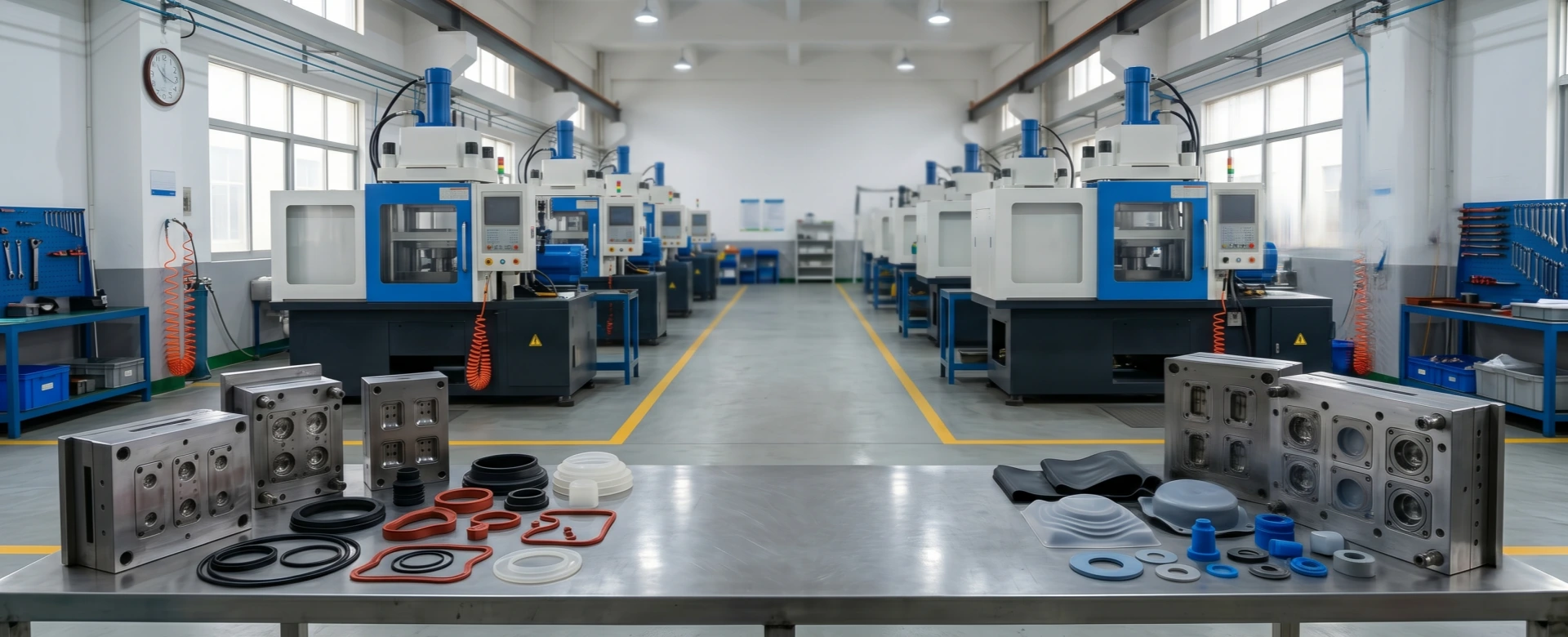
Reemane manufactures custom silicone sealing washers, molded washers, sealing rings, flat gaskets, and related molded silicone components based on STEP files, 2D drawings, physical samples, housing dimensions, or application requirements.
Low-Clamp-Force Seal Design at a Glance
Housing Review → Clamp-Load Limitation → Washer Geometry → Softness and Material → Controlled Sealing Area → Compression Stop → Prototype Leak Test → Long-Term Compression Validation
When Is a Low-Clamp-Force Silicone Washer Useful?
The design is most useful when the seal needs to deform easily but the surrounding assembly cannot tolerate high fastening force.
Thin Plastic Covers and Housings
Plastic covers may bend between screws or deform around fastening bosses. Excessive torque can also strip threads, damage inserts, crack molded bosses, or permanently distort the sealing flange.
A softer washer can reduce the force required to obtain useful deformation, but the cover still needs sufficient stiffness to distribute the clamp load around the full sealing perimeter.
Lightweight Electronic and Sensor Enclosures
Small electronics, control housings, sensors, lighting components, and other lightweight enclosures may need dust or moisture sealing without the mass and stiffness of a heavy metal flange.
In these assemblies, the available screw size, boss strength, enclosure stiffness, and internal component clearance can limit the acceptable clamp force.
Delicate Components
Some assemblies contain ceramic, optical, electronic, molded, or other sensitive components that should not receive excessive compressive load from the surrounding cover.
A compliant silicone washer can help isolate the sealing function from excessive structural loading when the housing geometry is designed correctly.
Repeatedly Opened Service Covers
A maintenance cover may be removed and reinstalled multiple times. If the seal requires very high or highly controlled screw torque every time, service consistency becomes difficult.
A properly designed soft washer with a defined compression stop can make the closed position more repeatable.
Design objective:
Use the lowest practical clamp load that still produces continuous and stable sealing contact across the real tolerance range of the assembly.
Why Softer Silicone Can Reduce the Required Closure Load
A softer silicone compound generally deforms more easily than a firmer compound under the same general geometry. This can help the washer conform around:
- Minor surface waviness
- Small molded surface variations
- Light machining marks
- Limited flange flatness variation
- Low-force cover closure
This is why lower-hardness silicone is often considered when the housing cannot provide substantial clamp force.
But Shore A hardness should not be treated as a direct clamp-force specification.
The actual force required to compress the finished washer also depends on:
- Silicone compound modulus
- Washer thickness
- Outside and inside diameter
- Total compressed area
- Amount of squeeze
- Lateral confinement
- Surface texture
- Temperature
- Compression rate
Important:
Two silicone materials with the same nominal Shore A hardness can still produce different compression forces and different long-term recovery.
A Wider Washer Does Not Automatically Mean Lower Clamp Force
One of the most important design decisions is the effective area being compressed.
A common assumption is that making the washer wider creates a stronger seal. A larger support area can sometimes improve stability, but increasing the total elastomer area can also increase the total force required to create a given average contact pressure.
For a low-clamp-force assembly, it can therefore be more effective to control where the sealing pressure is generated instead of compressing one very broad flat elastomer surface.
Broad Flat Silicone Washer
A conventional flat washer is structurally simple and can provide a wide support surface.
However, when a large portion of the washer is compressed at the same time, the assembly may require more total closure force. This can become a problem with thin covers or weak screw bosses.
Narrow Controlled Sealing Land
A narrower functional sealing area concentrates deformation into a smaller zone. This can help create the required local contact without compressing a much larger elastomer area unnecessarily.
The surrounding washer can still provide:
- Location in the assembly
- Handling support
- Anti-shift geometry
- Protection against incorrect installation
Molded Raised Sealing Bead
A custom molded washer can include one or more raised sealing lands rather than using a completely flat upper surface.
The bead contacts first during assembly, allowing the designer to control the initial sealing region while the remaining washer structure provides support.
This type of geometry normally requires
custom silicone compression molding
rather than simple sheet cutting.
DFM warning:
Do not make the sealing bead extremely narrow only to reduce clamp force. A very small land can become sensitive to molding variation, surface scratches, flash, parting-line position, and assembly misalignment.
Use Compression Stops Instead of Relying Only on Screw Torque
Screw torque does not directly equal washer compression. Friction in the screw threads, plastic boss, insert, washer, and mating surfaces can cause substantial variation between applied torque and the actual clamp force reaching the seal.
Soft silicone makes this especially important because the washer can continue deforming if there is no positive closed position.
A more repeatable assembly can use:
- Integrated housing stops
- Controlled groove depth
- Rigid compression limiters
- Shoulder screws
- Metal or plastic spacers
- Defined flange-to-flange contact surfaces
These features establish the final installed thickness of the washer.
A simple way to describe nominal compression is:
Nominal squeeze (%)
= (Free Washer Thickness − Installed Thickness) / Free Washer Thickness × 100
This equation describes geometry only. It does not establish the correct squeeze for every silicone washer.
The final compression should be determined from:
- Exact silicone compound
- Washer geometry
- Pressure or vacuum
- Surface condition
- Housing stiffness
- Temperature
- Service duration
- Required leakage performance
Why Over-Compressing a Soft Washer Can Cause Problems
A soft washer may initially appear to improve as the screws are tightened because the material continues conforming to the mating surfaces.
Beyond the useful compression range, additional tightening can create new problems rather than improving sealing.
Possible results include:
- Permanent thickness loss
- Reduced elastic recovery
- Bulging outside the intended sealing area
- Extrusion into clearance gaps
- Plastic-cover deformation
- Cracked or stripped screw bosses
- Uneven load around the perimeter
- Greater sensitivity to temperature cycling
This is why a low-clamp-force design should focus on controlled deformation rather than maximum deformation.
Compression Set Matters in Long-Term Static Sealing
A washer is compressed when the assembly is closed. Over time and temperature, the elastomer may not return completely to its original thickness after the load is removed.
This permanent deformation is one reason that material compression-set performance is relevant to static seals.
A low-clamp-force design can be particularly sensitive because there may be less excess clamp load available to compensate if the washer loses recovery.
Material review should therefore consider:
- Compression-set behavior of the exact compound
- Continuous operating temperature
- Time under compression
- Expected product life
- Whether the assembly will be reopened
- Whether the washer must reseal after service
Do not compare two materials only by their Shore A hardness. A softer material with suitable compression recovery may perform better than another material that has the same nominal hardness but different long-term behavior.
Thin Plastic Covers Need Deflection Control
A very soft washer cannot compensate for unlimited housing flexibility.
Consider a rectangular plastic cover secured by screws around its perimeter. Near each screw, the cover may compress the washer strongly. Halfway between two screws, the cover may bow upward.
The result can be:
- High compression beside the fasteners
- Low compression between the fasteners
- A leakage path at the middle of the span
Important housing variables include:
- Fastener spacing
- Cover material
- Cover wall thickness
- Rib structure
- Curvature
- Fastener position relative to the seal
- Compression-stop location
Prototype check:
Do not inspect washer compression only beside the screws. Check the sealing contact halfway between fasteners, where a flexible cover is most likely to lift.
Surface Finish and Flatness Still Matter
Soft silicone is useful because it can conform to small surface irregularities, but it cannot reliably compensate for every housing defect.
Review the sealing surfaces for:
- Warpage
- Sink marks
- Mold mismatch
- Parting-line steps
- Gate or ejector witness
- Machining marks
- Coating thickness variation
- Scratches crossing the sealing path
- Dust, oil, or assembly contamination
A soft washer may temporarily hide a surface problem during a hand test while still producing inconsistent mass-production sealing.
Pressure and Vacuum Still Require Sufficient Sealing Contact
Low clamp force does not mean that sealing pressure can be ignored.
The washer must remain supported and maintain contact under the actual differential pressure or vacuum condition.
Provide the manufacturer with:
- Internal or external pressure direction
- Normal operating pressure
- Peak pressure
- Vacuum level where applicable
- Clearance gaps around the washer
- Required leakage or ingress target
A very soft material can become more vulnerable to extrusion into an unsupported gap if the pressure and geometry are not controlled.
Material Compatibility Is More Than Hardness
The selected silicone must also be appropriate for the environment.
Include:
- Minimum and maximum operating temperature
- Water exposure
- Oil or grease
- Coolant
- Detergents and cleaning agents
- Process chemicals
- Outdoor UV and ozone exposure
- Humidity and thermal cycling
Standard silicone is useful across many temperature and weathering applications, but it is not automatically compatible with every oil, fuel, solvent, or chemical.
Reemane can discuss material and hardness direction after reviewing the exact operating conditions.
Molded Silicone Washer vs. Die-Cut Silicone Washer
Die-Cut Flat Washer
Die cutting can be practical when the product is a simple two-dimensional washer and suitable silicone sheet is available in the required:
- Material
- Hardness
- Thickness
- Surface condition
- Tolerance
It can reduce tooling complexity for simple flat geometries.
Compression-Molded Silicone Washer
Custom molding is more suitable when the washer requires:
- Raised sealing beads
- Multiple sealing lands
- Locating features
- Variable thickness
- Three-dimensional geometry
- Controlled molded edges
- Integrated tabs or support features
Reemane’s
custom silicone O-rings and washers
capability covers flat washers, molded washers, sealing rings, support rings, and related custom silicone components.
For wider sealing projects, see our
custom silicone seals and gaskets
manufacturing capability.
How to Validate a Low-Clamp-Force Washer Prototype
A prototype should be tested in the actual housing or in a fixture that represents the real assembly stiffness and closure condition.
- Measure the free washer thickness, ID, OD, and critical features.
- Confirm the exact silicone material and hardness direction.
- Measure the actual housing and cover tolerance.
- Assemble at the minimum expected closure condition.
- Assemble at the nominal condition.
- Evaluate the maximum expected closure condition.
- Confirm whether the housing reaches the intended compression stops.
- Inspect cover deflection between fasteners.
- Perform the relevant water, air, dust, vacuum, or leakage test.
- Condition the assembly at the required temperature where relevant.
- Maintain compression for a defined period when long-term sealing is important.
- Open the assembly and inspect washer recovery.
- Check for bulging, extrusion, tearing, or permanent deformation.
- Repeat the test at dimensional tolerance extremes where necessary.
Approval principle:
The correct washer is the one that maintains the required seal across the real assembly tolerance range without requiring clamp force that damages, distorts, or permanently overstresses the surrounding structure.
Common Low-Clamp-Force Sealing Problems
The Cover Leaks Between Screws
Review cover stiffness, fastener spacing, sealing-line position, compression stops, and the minimum washer compression between fastening points.
The Plastic Cover Warps When Tightened
Review the total compressed washer area, material hardness, cover wall thickness, rib structure, screw torque, and whether a narrower controlled sealing land could reduce the required total closure force.
The Washer Bulges Outside the Joint
Review excessive squeeze, unsupported clearance, washer volume, groove width, material softness, and the closed position of the housing.
The Seal Works Initially but Leaks After Aging
Review compression set, temperature, long-term deformation, housing relaxation, screw preload, chemical exposure, and whether the initial design depended on excessive compression.
The Washer Does Not Reseal After Opening the Cover
Review permanent deformation, material recovery, service temperature, surface contamination, washer damage, and whether the product is intended for repeated disassembly.
How Reemane Supports Soft Silicone Washer Projects
Reemane supports custom silicone sealing washers and related static sealing components for enclosures, equipment, electronics, lighting, machinery, appliances, and other OEM applications.
Projects can begin from:
- STEP or other available 3D files
- 2D engineering drawings
- A physical washer sample
- Housing and cover samples
- Assembly photographs
- Basic dimensions
- An existing seal that requires too much screw torque
- A leaking assembly that needs redesign
Based on the available information, we can discuss:
- Silicone hardness direction
- Washer thickness and profile
- Flat washer vs. molded sealing land
- Compression stops
- Parting line and mold design
- Prototype sampling
- Inspection dimensions
- Production quantity
- Packaging and handling
Information Needed for a Low-Clamp-Force Washer Quote
- Washer STEP file, 2D drawing, physical sample, or clear product photographs
- Free washer ID, OD, thickness, and critical tolerances
- Housing and cover drawings
- Mating sealing-surface dimensions and flatness requirements
- Fastener quantity, size, location, and spacing
- Available screw torque or maximum clamp-load limitation if known
- Mechanical stop, groove, shoulder, spacer, or limiter dimensions
- Operating pressure, vacuum, or ingress-sealing requirement
- Operating temperature and contact media
- Target silicone material, Shore A hardness, color, and surface requirement
- Prototype quantity, first production quantity, and estimated annual usage
- Existing problems such as leakage, warped covers, stripped bosses, excessive torque, extrusion, or permanent compression
Need a Seal That Works Without Heavy Clamp Force?
Send Reemane your washer drawing, housing dimensions, fastener layout, operating conditions, current sealing problem, and estimated quantity. We can review the material direction, sealing area, compression control, mold requirements, prototype plan, and information needed for quotation.
Download the Reemane Technical Guide
Save, share, or forward the engineering version of this article:
Low-Clamp-Force Sealing with Soft Silicone Washers,
published by Shenzhen Reemane Silicone Technology Co., Ltd.
Frequently Asked Questions
Does softer silicone always require less clamp force?
Softer silicone generally deforms more easily, but the actual clamp force also depends on compound modulus, washer thickness, compressed area, geometry, squeeze, confinement, and temperature. Hardness alone is not enough to predict the assembly force.
Should I make the washer wider to improve sealing?
Not automatically. A wider washer increases the elastomer area being compressed and may increase the total closure force. A narrower controlled sealing land or molded bead may be more efficient in a low-clamp-force design, depending on the housing and surface condition.
What Shore A hardness should a soft silicone sealing washer use?
There is no universal hardness. The correct direction depends on washer geometry, clamp-load limitation, housing stiffness, operating temperature, pressure, contact media, and long-term compression requirements. Prototype testing with the actual assembly is recommended.
Why is a compression stop important?
A compression stop defines the closed position of the assembly and prevents the washer from being compressed indefinitely as the screws are tightened. This can improve repeatability and protect soft silicone, plastic covers, and screw bosses from excessive load.
Why does a plastic cover leak between screws?
The cover may bow between fastening points, producing high compression near the screws and insufficient compression in the middle. Review fastener spacing, cover stiffness, sealing-line location, and compression-stop geometry.
Can soft silicone be used for pressure sealing?
It can be suitable for selected static pressure or vacuum applications, but the material must remain supported and maintain sufficient contact under the actual differential pressure. Pressure direction, clearance gaps, extrusion risk, temperature, and media must be reviewed.
Is a molded washer better than a die-cut washer?
Neither process is universally better. Die cutting can be efficient for simple flat washers. Compression molding is more suitable when the design requires raised sealing beads, locating features, variable thickness, controlled molded edges, or other three-dimensional features.
What should I send Reemane for a custom sealing washer quotation?
Send the washer drawing or sample, housing and cover dimensions, fastener layout, available clamp load or screw torque, operating pressure, temperature, contact media, sealing requirement, prototype quantity, and expected production quantity.