 Silicone Manufacturer for Custom Silicone Products
Silicone Vibration Dampeners and Isolation Mounts for Industrial Drones and Camera Gimbals
In industrial unmanned aerial vehicles (UAVs) and high-precision optical camera gimbals, mechanical vibration isolation functions as a primary boundary parameter dictating flight control stability and sensory data integrity. During multi-rotor flight operations, high-frequency structural harmonics generated by brushless motors and aerodynamic blade loads pass directly through the carbon-fiber frame. Without complete localized kinetic isolation, these structural vibrations reach the internal inertial measurement units (IMUs) and optical sensor matrices, introducing gyro drift, electronic tracking anomalies, and severe image distortion known as the jello effect.
To eliminate these kinematic deviations while certifying robust environmental protection across extreme flight envelopes, aerospace sourcing and design groups specify custom-formulated, low-durometer Liquid Silicone Rubber (LSR) vibration dampeners and isolation balls. Sourcing and engineering these micro-elastomeric mounts requires precise optimization of non-linear viscoelastic hysteresis loops, strict control over the polymer matrix loss factor, and flashless multi-cavity injection molding execution to ensure consistent dynamic spring rates across mass production lots.
1. Viscoelastic Wave Kinetics: Managing the Polymer Loss Factor
Elastomeric isolation works by converting kinetic vibration energy into thermal energy. Under continuous high-frequency dynamic shearing forces, silicone displays a complex viscoelastic behavior, where its mechanical response splits into an elastic in-phase component and a viscous out-of-phase component. The dynamic mechanical properties of the isolation mount are defined by the complex shear modulus (G*), which comprises the Storage Modulus (G’) representing elastic energy storage, and the Loss Modulus (G”) representing energy dissipation through molecular friction:
The fundamental efficiency of a drone dampening ball is dictated by its Loss Factor (tan δ), which represents the mathematical ratio of energy dissipated to energy stored per cycle of deformation:
Standard industrial rubbers exhibit an unstable loss factor that drops significantly during sub-zero high-altitude flights, causing the material to harden and pass high-frequency vibration tracks directly to the camera payload. Reemane customizes the siloxane polymer cross-link networks using specific vinyl-terminated dimethylsiloxane copolymer structures reinforced with fumed silica fillers. This polymer formulation maintains a stable, high loss factor (tan δ ≈ 0.35 to 0.55) across an extensive operating temperature spectrum (-50°C to +150°C). This thermal stability ensures continuous mechanical dampening, preventing high-frequency motor harmonics from compromising sensory data during sub-zero high-altitude mapping missions or high-heat inspection operations.
2. Geometric Design Optimization and Mechanical DFM of Isolation Mounts
When engineering protective silicone dampening balls for camera gimbals, the geometric profile must balance multi-axial structural stiffness requirements. The mount must feature sufficient shear compliance to isolate high-frequency vibrations along the vertical and horizontal axes, while maintaining enough tensile stiffness to support the dead-weight payload of the optical camera without sagging or tracking displacement during high-speed flight turns.
Advanced Design for Manufacturing (DFM) layouts utilize a hollow spherical geometry incorporating a specialized internal neck configuration. The compression pre-load applied during assembly must be tightly controlled:
- Pre-Load Compression Limits: To prevent mechanical bottoming-out and maintain an optimal dynamic spring rate, the axial assembly pre-load is restricted to a target range of 12% to 20% compression.
- Poisson Volume Displacement Relief: Because cured silicone behaves as an incompressible fluid under mechanical load, the internal spherical cavity provides the necessary volume displacement relief space. This space prevents the elastomer from binding tightly under extreme structural tension, allowing the mount to absorb sudden impact energy peaks during wind gusts or hard landings.
3. Performance Isolation Material Comparison Matrix
| Performance Criteria | Reemane Dynamic LSR (35 Shore A) | Industrial Polyurethane (PU) | Standard Natural Rubber |
|---|---|---|---|
| Thermal Damping Stability (-20°C to 60°C) | Premium (Variance ≤ 5% across full thermal sweep) | Poor (Hardens dramatically at sub-zero cold fronts) | Moderate (Suffers accelerated thermal cracking) |
| Flex-Fatigue Life (ASTM D430 B) | Premium (15M+ cycles with zero spring-rate decay) | Moderate (Prone to internal micro-void breakdown) | Poor (Suffers permanent structural deformation) |
| Environmental Weathering Resistance | Immune (Complete UV, ozone, and salt-fog defense) | Moderate (Yellows and degrades under UV exposure) | Fails (Suffers rapid oxidation breakdown cracks) |
4. High-Volume Precision Manufacturing: Liquid Silicone Rubber (LSR) Multi-Cavity Tooling
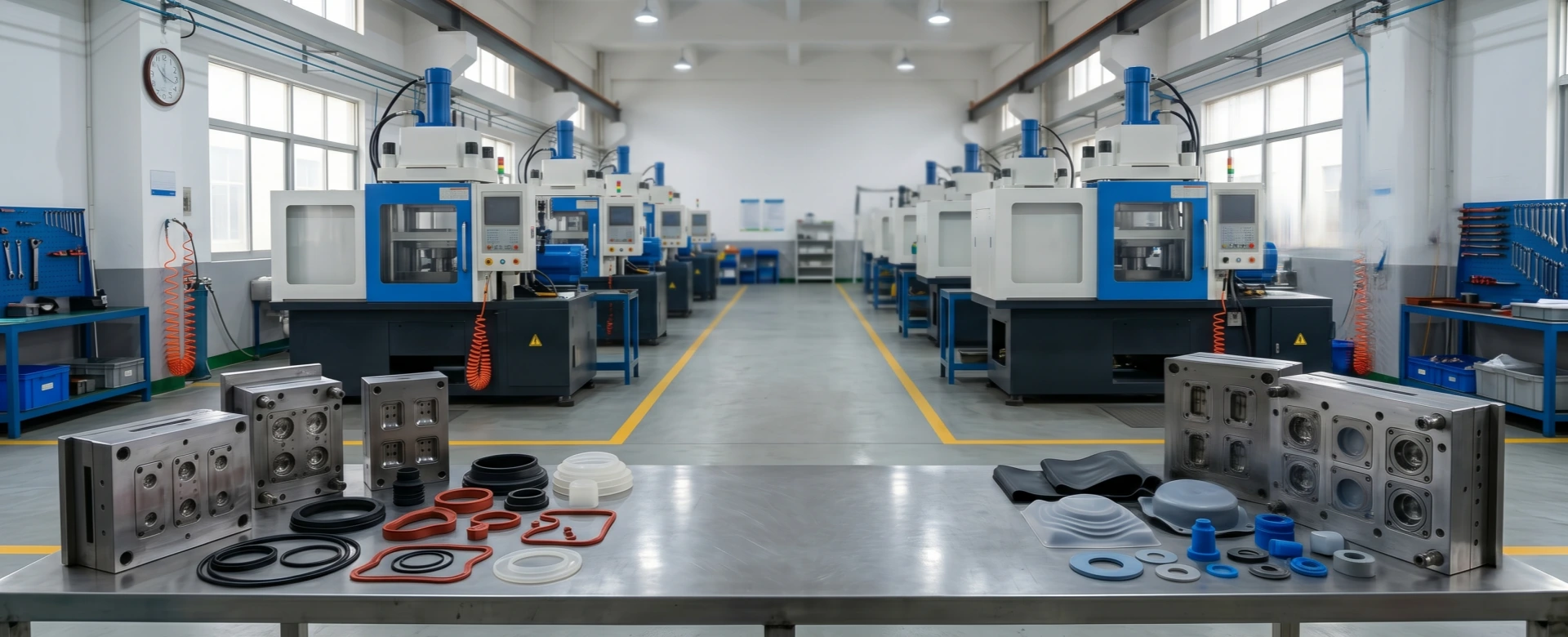
The micro scale of dynamic aerospace components—where gimbal dampening mounts often feature thin-walled retention channels and deep internal spherical recesses—demands exceptional precision during tool mold manufacturing. Because raw Liquid Silicone Rubber (LSR) exhibits a very low viscosity at elevated vulcanization temperatures, any parting line clearance gap exceeding 5 microns (0.005 mm) will allow liquid silicone to escape, creating ultra-thin molding flash defects.
Molding flash along the clamping channels or internal neck interfaces creates an immediate operational failure. The vestigial flash material alters the nominal mechanical pre-load force during assembly, shifts the calibrated dynamic spring rate, and introduces asymmetric dampening anomalies that degrade gimbal control performance. To prevent these defects, Reemane uses advanced CNC micro-machined tool steel molds equipped with cold-runner valve gates, paired with automated flashless demolding ejection blocks. This precision tooling configuration completely eliminates flash generation, ensuring highly consistent mechanical properties and a stable manufacturing process capability index ($C_{pk} \ge 1.67$).
5. Rigorous Laboratory Quality Assurance and Qualification
To satisfy the strict procurement standards of industrial UAV system integrators and aerospace defense groups, every manufacturing lot undergoes intensive testing within a fully accredited laboratory facility. The qualification sequence isolates specific structural and environmental failure modes:
- ISO 16750-3 Random Mechanical Vibration Subjection: Assembled isolation mounts are loaded onto high-frequency triaxial shakers within environmental chambers. The components are subjected to broad-spectrum random vibration profiles across extreme temperature sweeps (-50°C to +150°C) to verify that the dampening mounts introduce zero resonance spikes or structural cracking.
- ASTM D430 De Mattia High-Frequency Flex Fatigue Testing: Molded mounts undergo continuous high-speed mechanical extension and compression runs at 5 Hz. The material must survive 15 million cycles with a dynamic spring rate deviation of less than 5%.
- ASTM G154 Accelerated UV Weathering Exposure: Samples are exposed to high-intensity UV radiation and intense salt-fog sprays for 1000 hours to confirm zero surface cracking, hardening, or loss of structural flexibility.
Eliminate Jello Artifacts with Reemane High-Precision UAV Sealing Assets
Eradicate structural high-frequency vibration tracks, eliminate micro-flash spring rate anomalies, and maintain flawless viscoelastic damping performance across extreme operating environments. Reemane provides full non-linear dynamic mechanical analysis modeling, automated flashless injection micro-tool setups, and certified ISO 16750-3 environmental validation data logs.