 Silicone Manufacturer for Custom Silicone Products
1. The Disconnect Between Form and Function in Rapid Prototyping
In the high-stakes environment of New Product Introduction, hardware engineers are under immense pressure to validate the form, fit, and function of an elastomeric component before authorizing capital expenditure for a mass-production steel mold. The defining challenge in silicone prototyping is the severe disconnect between geometric representation and mechanical reality. While modern rapid prototyping can effortlessly replicate the physical dimensions of a Three-Dimensional Computer-Aided Design model, evaluating whether an O-ring will actually hold fluid pressure or if a keypad will survive a ten-million-cycle fatigue test requires absolute material fidelity.
If an Original Equipment Manufacturer utilizes a prototyping methodology that mimics the shape but fundamentally alters the polymer physics, the resulting physical tests are invalid. Approving a design based on a false positive from a compromised prototype leads directly to catastrophic failures in the field. This technical specification deconstructs the three dominant silicone prototyping pathways—Room Temperature Vulcanization urethane casting, additive manufacturing (3D printing), and rapid prototype tooling—evaluating their thermodynamic, metrological, and mechanical validity.
NPI Engineering Axiom: Geometric accuracy is useless without material fidelity. Validating a high-temperature automotive seal using a polyurethane cast or an anisotropic 3D print generates false positive data that will catastrophically fail in a mass-production thermal environment.
2. Polyurethane Vacuum Casting (RTV Silicone Molds)
The most common and historically ubiquitous method for generating low-volume flexible prototypes is Room Temperature Vulcanization (RTV) silicone molding, frequently paired with polyurethane vacuum casting. In this process, a master pattern is 3D printed and encased in liquid RTV silicone. Once the silicone cures, the master is removed, and liquid thermosetting polyurethane resins are poured into the resulting void under a vacuum.
While this method produces visually impressive parts quickly and inexpensively, it is an engineering trap. Polyurethane rubber is fundamentally not silicone rubber. Although polyurethanes can be formulated to mimic a target Shore A durometer (e.g., 50A), their chemical backbone is entirely different. They fail to replicate the extreme thermal stability, chemical resistance, and unique compression set profile of a true siloxane polymer. An automotive engineer testing a polyurethane prototype in an engine compartment environment will experience a catastrophic thermal meltdown, rendering the validation test completely useless.
3. Additive Manufacturing: Direct Silicone 3D Printing
In recent years, the advancement of direct silicone 3D printing (utilizing extrusion or Drop-on-Demand jetting technologies) has promised to revolutionize elastomeric prototyping. This pathway offers the undeniable advantage of generating complex internal geometries—such as intersecting fluidic channels or hollow honeycomb structures—that are physically impossible to mold via traditional CNC steel tooling.
However, true engineering validation demands mechanical isotropy. 3D printing is inherently an anisotropic process; the material is built in microscopic layers along the Z-axis. While the XY plane may exhibit robust tensile strength, the adhesion between the vertical layers is frequently a severe weak point. If a 3D-printed silicone seal is subjected to extreme elongation or pneumatic pressure testing, it will almost certainly delaminate and rupture along these layer lines. Furthermore, the viscosity modifiers required to make the silicone printable often alter the final compression set, making it an unreliable analog for the performance of a high-pressure, heat-vulcanized production part.
4. The Gold Standard: Rapid Prototype Tooling (Soft Steel/Aluminum)
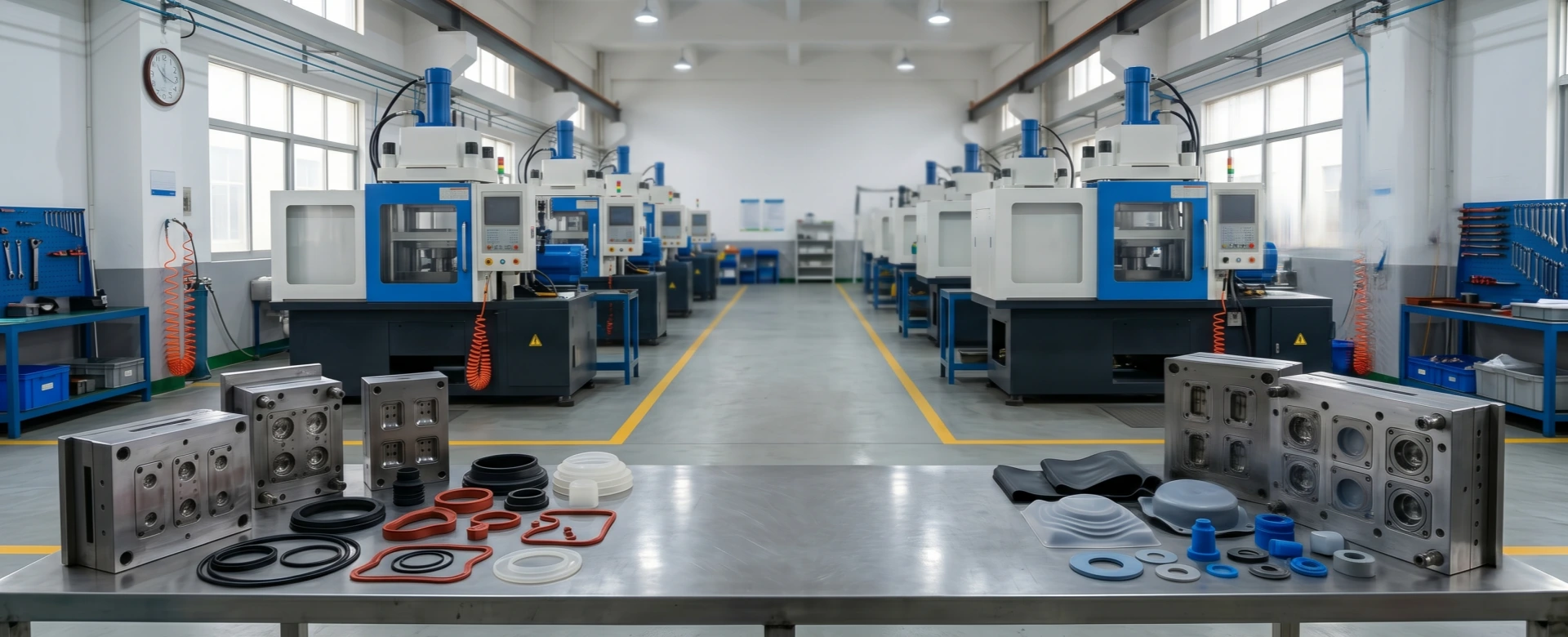
For Original Equipment Manufacturers requiring absolute, uncompromising engineering data, Reemane Silicone explicitly mandates Rapid Prototype Tooling. This methodology bypasses synthetic analogs and layered printing entirely. Instead, we utilize high-speed Computer Numerical Control milling to cut a single-cavity or low-cavitation mold from aluminum (such as Alumec 89) or pre-hardened soft steel (P20).
This pathway allows the engineer to shoot the exact, final-grade Liquid Silicone Rubber or High-Consistency Rubber that will be used in mass production. The prototype component is subjected to the same extreme thermodynamic heat and hydraulic compression as the final product. The resulting part boasts one hundred percent material fidelity, absolute mechanical isotropy, and strict adherence to Geometric Dimensioning and Tolerancing standards. A gasket validated from prototype tooling guarantees seamless, zero-defect scaling to multi-cavity mass production.
| Prototyping Methodology | Material Fidelity | Mechanical Isotropy | Validation Confidence |
|---|---|---|---|
| Polyurethane Vacuum Casting (RTV) | Fake (Uses urethane analog, not silicone). | High (Solid cast structure). | Low (Fails thermal & chemical testing). |
| Direct Silicone 3D Printing | High (Uses real silicone polymers). | Low (Severe Z-axis layer weakness). | Moderate (Fails elongation & pressure limits). |
| Rapid Prototype Tooling (Al/Steel) | Absolute (Exact mass-production material). | Absolute (Fully vulcanized matrix). | 100% Guaranteed (Seamless scaling). |
Execute Flawless Engineering Validation
Do not base your multi-million-dollar tooling investments on compromised data from urethane analogs or anisotropic 3D prints. Partner with Reemane Silicone to deploy rapid prototype tooling that utilizes the exact thermodynamic and material profiles required for mass production. To initiate a rapid tooling engineering analysis, contact our New Product Introduction desk at sales@siliconefactories.com or inspect our CNC machining capabilities at www.siliconefactories.com.