 Silicone Manufacturer for Custom Silicone Products
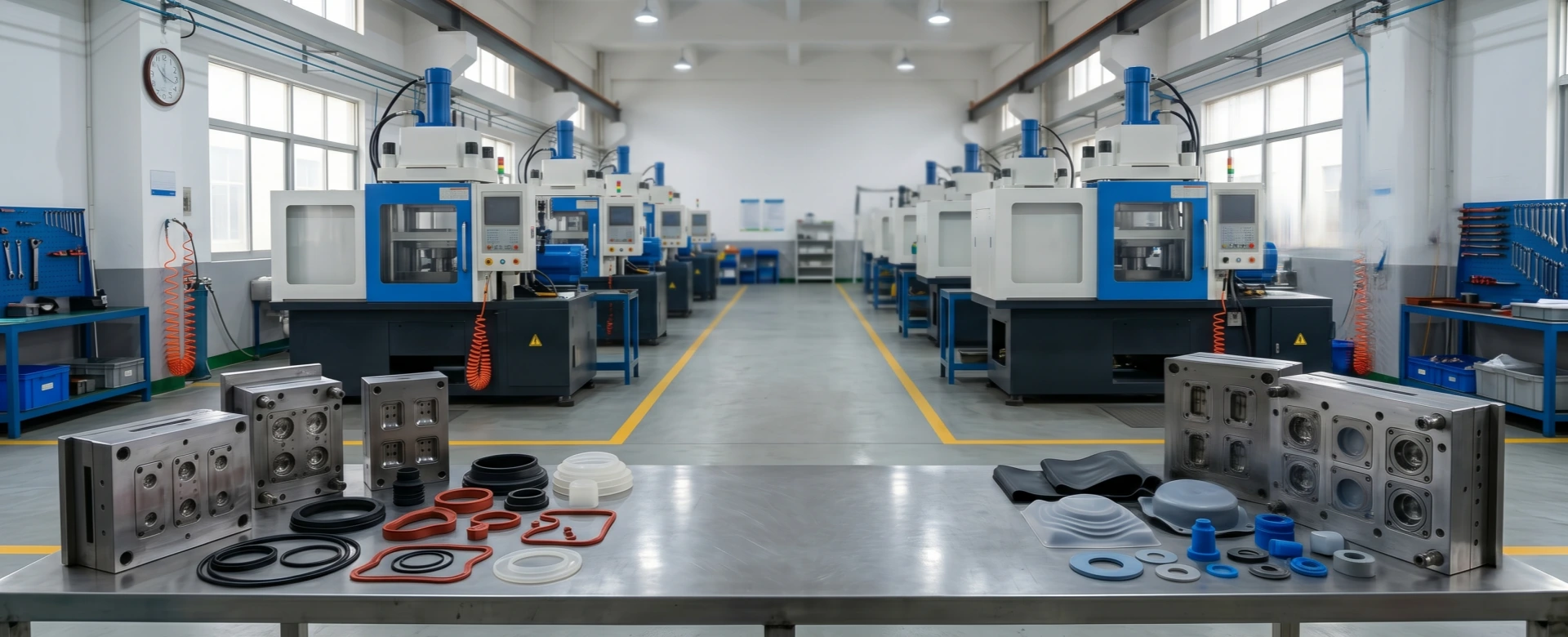
Selecting the Right Mold Steel: Why S136 Hardened Steel Beats P20 for Long-Run Silicone Tooling
In B2B contract manufacturing, selecting an appropriate cavity mold steel is the most critical factor determining long-term capital efficiency and part consistency. A frequent error among sourcing managers is treating elastomer molding steel requirements identically to standard thermoplastic tooling specifications. Because unvulcanized silicone compounds possess low initial viscosities compared to molten rigid plastics, there is a common misconception that tooling environments experience minimal mechanical stress, justifying the use of budget-friendly, pre-hardened steels like P20.
This assumption overlooks the unique chemical and physical realities of continuous silicone cross-linking. High-consistency rubber (HCR) compression blocks and liquid silicone rubber (LSR) injection streams subject molds to elevated operational temperatures ($170^{\circ}C$ to $210^{\circ}C$), constant moisture exposure, aggressive curing outgassing byproducts, and abrasive shear forces from dense silica fillers ($SiO_2$). For long-run multi-million cycle programs, running P20 steel leads to premature cavity degradation, parting line washout, and severe flashing, whereas through-hardened S136 stainless mold steel maintains absolute profile precision.
1. Metallurgical Comparison: S136 ESR vs. P20 Pre-Hardened Steel
Understanding why S136 outperforms P20 requires analyzing their distinct chemical compositions and heat treatment states. P20 is a low-alloy Chrome-Moly plastic mold steel delivered in a pre-hardened condition, typically hovering between 30 and 36 HRC. Because it is machined in its final hardness state, it is optimized for speed of tool cutting rather than maximum wear resistance. Its low chromium content (~1.2%) leaves it highly vulnerable to oxidation and corrosive attack at elevated processing temperatures.
Conversely, S136 is a high-chromium martensitic stainless mold steel—equivalent to AISI 420 or DIN 1.2083 standards—typically refined via Electroslag Remelting (ESR). S136 is machined in an annealed state and subsequently subjected to a rigorous through-hardening vacuum heat treatment, elevating its final hardness profile to 48–52 HRC. With a massive chromium content of approximately 13.0%, S136 builds a passive chromium oxide protective boundary layer that resists chemical degradation and physical erosion.
2. Cavity Degradation Mechanics: Volatile Acid Attack and Abrasive Wear
During volume production runs, tool cavities face two primary destructive forces that rapidly degrade soft steel tool faces:
- Volatile Acid Etching: Silicone compounding recipes rely on specific cross-linking catalysts. Peroxide-cured HCR lines yield volatile organic byproducts during vulcanization, including benzoic acid and 2,4-dichlorobenzoic acid. At tool temperatures exceeding 170°C, these vapors condense on cold zones or vent paths, chemically etching soft P20 steel and causing micro-pitting on mirror-polished cavities. S136’s 13% chromium lattice remains completely inert to these volatile acids.
- Abrasive Silica Washout: Premium high-tear silicone formulations are heavily reinforced with amorphous fumed silica ($SiO_2$) nano-particles to improve mechanical properties. Under high injection pressures and fast velocities inside LSR cold runner networks, these hard silica particles act as a microscopic sandblasting stream. Soft P20 steel faces wear away rapidly at high-velocity gate entries and sharp parting lines, a defect known as tool washout. Through-hardened S136 resists this abrasive micro-scratching, preserving tool geometry over millions of cycles.
3. Hard Performance Profile: S136 vs. P20 Tooling Metrics
Evaluating tool steels under strict quality validation standards reveals the operational thresholds of both alloys. Through-hardened S136 delivers superior mechanical performance across all long-run production metrics.
Tooling Material Performance Profile
| Metallurgical Property | Testing Standard / Metric | P20 Pre-Hardened Steel | S136 Through-Hardened Steel |
|---|---|---|---|
| Delivery Hardness | Rockwell C Scale (HRC) | 30 – 36 HRC (Soft) | 48 – 52 HRC (Through-Hardened) |
| Chromium Content | Elemental Mass Fraction (%) | ~ 1.20% Chromium | ~ 13.00% Chromium (Stainless) |
| Corrosion Resistance | Acid Gas Exposure / Condensation | Poor (Prone to pitting/etching) | Excellent (Inert to volatile acids) |
| Polishability Threshold | SPI Surface Finish Class | SPI-B1 (Medium Gloss) | SPI-A1 (Diamond Mirror Polish) |
| Target Tool Life | Continuous Production Cycles | 50,000 – 100,000 cycles | 1,000,000+ cycles (Guaranteed) |
4. Economic Framework: Amortization Over Multi-Million Cycle Lifespans
From a procurement and total cost of ownership (TCO) perspective, choosing P20 steel to save on initial tooling costs is often a costly miscalculation for volume programs. While a P20 tool core may reduce upfront machining costs by 15% to 20% compared to an S136 block, its shorter operational lifespan quickly eliminates these savings. Once a tool encounters parting line washout, flash dimensions expand past acceptable tolerances, requiring the production line to halt for manual tool pulling, laser welding repairs, and parting line re-machining.
These maintenance intervals trigger expensive production downtimes, late delivery penalties, and high scrap rates. An S136 tool requires a higher initial investment but completely amortizes this cost by running continuously without major maintenance over millions of cycles. By eliminating tool maintenance intervals, S136 yields a significantly lower piece-price cost over the lifecycle of high-volume B2B supply chains.
5. DFM Guidelines for High-Cavity Optical and High-Gloss Tooling
When engineering high-volume cosmetic components—such as optical clear LSR lenses for automotive light bars, medical wearables, or consumer electronic interfaces—S136 is an absolute technical requirement. Achieving an SPI-A1 diamond mirror polish requires an incredibly dense, inclusion-free steel matrix. S136 refined via Electroslag Remelting (ESR) eliminates microscopic slag impurities, ensuring that diamond lapping compounds can create a flawless, mirror-like finish that transfers directly to the molded silicone surface.
To maximize tool life, product blueprints must incorporate a minimum draft angle of 0.5° to 1.0° on all vertical walls to minimize friction during part ejection. Parting line shut-offs should be designed with tight tolerances ($\pm0.005\text{ mm}$) to leverage S136’s high yield strength, preventing the mold edges from collapsing under high clamping tonnages. Following these DFM parameters ensures consistent, zero-defect mass production runs.
Secure High-Volume Production Stability with S136 Hard Tooling
Eliminate parting line washout, prevent volatile acid pitting defects, and achieve a permanent SPI-A1 diamond mirror surface finish for your critical high-volume component lines. Reemane provides comprehensive metallurgical material certification logs, through-hardening recipe documentation, and guaranteed multi-million cycle tooling lifespans.