 Silicone Manufacturer for Custom Silicone Products
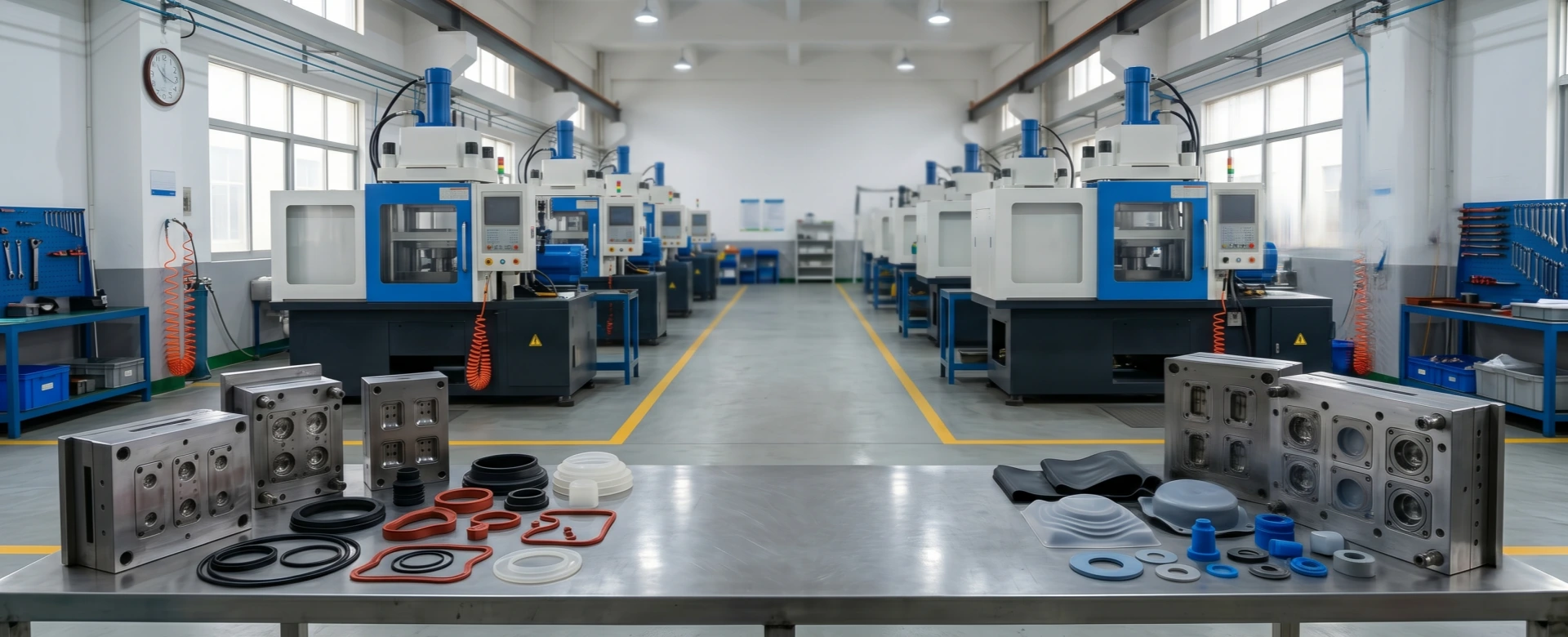
Silicone Bellows and Protective Dust Boots for Robotics and Heavy Industrial Machinery
In high-speed automated robotics and multi-axis heavy industrial machinery, moving articulations require continuous protection against harsh environmental contaminants. Industrial components—such as ball screws, linear guide rails, optical encoder paths, and hydraulic piston shafts—operate under constant exposure to abrasive metal shavings, grinding dust, oil splash, chemical solvents, and high-temperature welding slag. Failure to completely isolate these dynamic friction interfaces leads to accelerated abrasive wear, loss of kinematic positioning accuracy, and costly production line downtime.
Silicone bellows and dust boots function as flexible, hermetic isolation barriers engineered to expand, contract, and flex along multiple axes without failing under stress. Traditional protective sleeves fabricated from neoprene, nitrile (NBR), or polyurethane (PU) lack the required combination of high thermal stability and long-term flex-fatigue life. Under continuous cyclic motion, standard polymers experience hysteretic heat buildup and localized ozone oxidation, which cause material hardening and early structural cracking. Designing an industrial silicone protection boot requires precise optimization of the bellow’s geometric convolution profiles, a deep understanding of hyperelastic fatigue mechanics, and strict process control during high-volume compression and injection molding cycles.
1. Fatigue Mechanics and Convolution Geometry Optimization
During automated multi-axis robot movements, protective bellows undergo continuous, rapid extension and compression cycles at frequencies up to 5 Hz. This movement generates localized alternating tensile and compressive stresses, particularly within the inner and outer radii of the bellow convolutions. If the geometric profile applies unequal stress across the convolutions, the material will develop microscopic fissures at the high-strain points, leading to catastrophic fatigue tears.
To maximize service life, the mechanical stress profile of the elastomer is calculated across its travel limits using a non-linear modified shell deflection framework. The maximum localized bending stress (σmax) occurring within a single convolution wall is governed by the following geometric relationship:
Where Cf represents an empirical shape factor determined by the convolution angle, Esec is the hyperelastic secant modulus of the selected silicone formulation, t represents the nominal wall thickness of the bellow sleeve, δ is the linear axial deflection applied per convolution, w is the functional convolution height (the radial depth from the outer apex to the inner hinge), and Rc represents the mean radius of the convolution vertex curvature.
To minimize the peak stress value, Reemane Design for Manufacturing (DFM) layouts apply a tapered wall configuration. By maintaining a thickness of 1.50 mm along the straight flanks and tapering down to 1.00 mm at the vertex radii, the design distributes the strain field uniformly across the entire convolution. This stress management reduces localized hysteretic heat buildup and extends the bellow’s operational lifespan beyond 10 million continuous flex cycles without dimensional drift.
2. Polymer Physics: Optimizing HCR and LSR Formulation for High Tear Strength
Industrial bellows are frequently exposed to external hazards, such as sharp metal chips or ragged edge debris from heavy machining processes. If the elastomeric material exhibits low tear strength, a single microscopic puncture or nick caused by a sharp metal shard will quickly propagate into a large structural tear under continuous extension tension, compromising the environmental seal.
To eliminate the risk of tear propagation, Reemane utilizes high-molecular-weight High-Consistency Rubber (HCR) and premium Liquid Silicone Rubber (LSR) bases reinforced with vinyl-functional polysiloxane networks and high surface area fumed silica fillers. The filler networks are surface-treated with organosilane agents to establish strong covalent bonds with the siloxane polymer chains, raising the baseline cross-link density. This polymer engineering delivers a premium mechanical profile: high tear resistance exceeding 45 N/mm under ASTM D624 Die B protocols to stop notch propagation, combined with excellent compression set retention (≤ 15% after 22h @ 150°C) to maintain a perpetual, tight clamping seal over machine shafts.
3. Technical Performance Matrix: Industrial Isolation Elastomers
| Performance Metric | High-Tear HCR Silicone (50 Shore A) | Precision LSR Silicone (60 Shore A) | Conventional Neoprene / Polyurethane |
|---|---|---|---|
| Dynamic Flex Life (ASTM D430 B) | Excellent (10M+ cycles without micro-cracking) | Premium (Superior flashless cyclic consistency) | Poor (Suffers early flex cracking at < 1.5M cycles) |
| Operational Temp Spectrum | -55°C to +220°C (Stable flexibility profiles) | -50°C to +200°C (Zero thermal hardening) | -20°C to +100°C max (Experiences hardening hot) |
| Ozone & Corona Degradation | Immune (Zero atmospheric cracking channels) | Immune (Maintains structural bond) | Highly Vulnerable (Rapid ozonolysis breakdown) |
4. Tooling DFM and Demolding Strategies for Deep Convolutions
Manufacturing silicone bellows presents complex production challenges due to the deep undercut geometries inherent in convolution profiles. During the molding cycle, the cured silicone bellow must be extracted from the solid steel core without tearing the internal sealing lips or damaging the sharp vertex radii. To ensure repeatable, flashless production capabilities, Reemane implements specialized tooling configurations:
- Collapsible Core Tooling Technology: For intricate bellow profiles, internal cores utilize segmented, mechanically collapsing slides that retract inward prior to parts extraction. This movement completely removes the mechanical interference path, allowing automated demolding arms to pull the bellows free without applying structural tension to the hot rubber matrix.
- High-Pressure Air-Assisted Ejection: Tooling layouts incorporate discrete pneumatic injection micro-valves along the core parting line. Blasting compressed air at 6 bar expands the silicone bellow uniformly, allowing it to stretch safely over solid core shoulders during demolding before snapping back cleanly to its nominal dimensions via the material’s excellent elastic recovery.
5. Laboratory Quality Assurance: Verifying Critical Durability Limits
To satisfy the strict validation requirements of automation OEMs and machinery integration groups, every manufacturing lot undergoes intensive testing inside a fully accredited metrology laboratory. The qualification sequence isolates specific structural and environmental failure modes:
- ASTM D430 De Mattia Flex Fatigue Testing: Molded bellow segments are mounted into automated mechanical fixtures that continuously compress and extend the component at a fixed cycle frequency. The material must survive the targeted lifecycle run without developing microscopic surface cracks or structural delamination tracks along the inner vertex lines.
- ISO 16750-5 Chemical Fluid Ingress Exposure: Finished boots are exposed to intensive fluid splash testing involving industrial cutting fluids, hydraulic lubricants, diesel fuels, and aggressive automated washing solvents. Post-exposure verification requires the silicone to maintain a swell volume of ≤ 10% and retain ≥ 85% of its original tensile properties.
- ISO 13849-1 Component Reliability Validation: Mechanical testing logs are compiled to establish the Mean Time to Dangerous Failure (MTTFd) data sets required by safety system designers for automated factory machine certifications.
Maximize Automation Equipment Lifespans with Reemane High-Fatigue Silicone Bellows
Eliminate localized thermal breakdown pathways, eradicate wire harness chafing failures, and maintain flawless batch quality tracking across extreme high-temperature vehicle compartments. Reemane provides full hyperelastic radial sealing DFM geometry profile mapping, automated flashless injection tool setups, and certified USCAR-2 Class 4 validation reporting.