 Silicone Manufacturer for Custom Silicone Products
Minimum Order Quantities in Custom Silicone Molding Explained: The Factory Cost Structure
In the custom polymer manufacturing industry, product developers and procurement engineers frequently encounter strict minimum order quantity requirements when sourcing custom silicone components. A common misconception among external buyers is that these volume thresholds are arbitrary barriers imposed by the manufacturer to artificially inflate invoice totals. In reality, the minimum order quantity is a strict mathematical necessity dictated by the uncompromising physics and economics of industrial molding equipment.
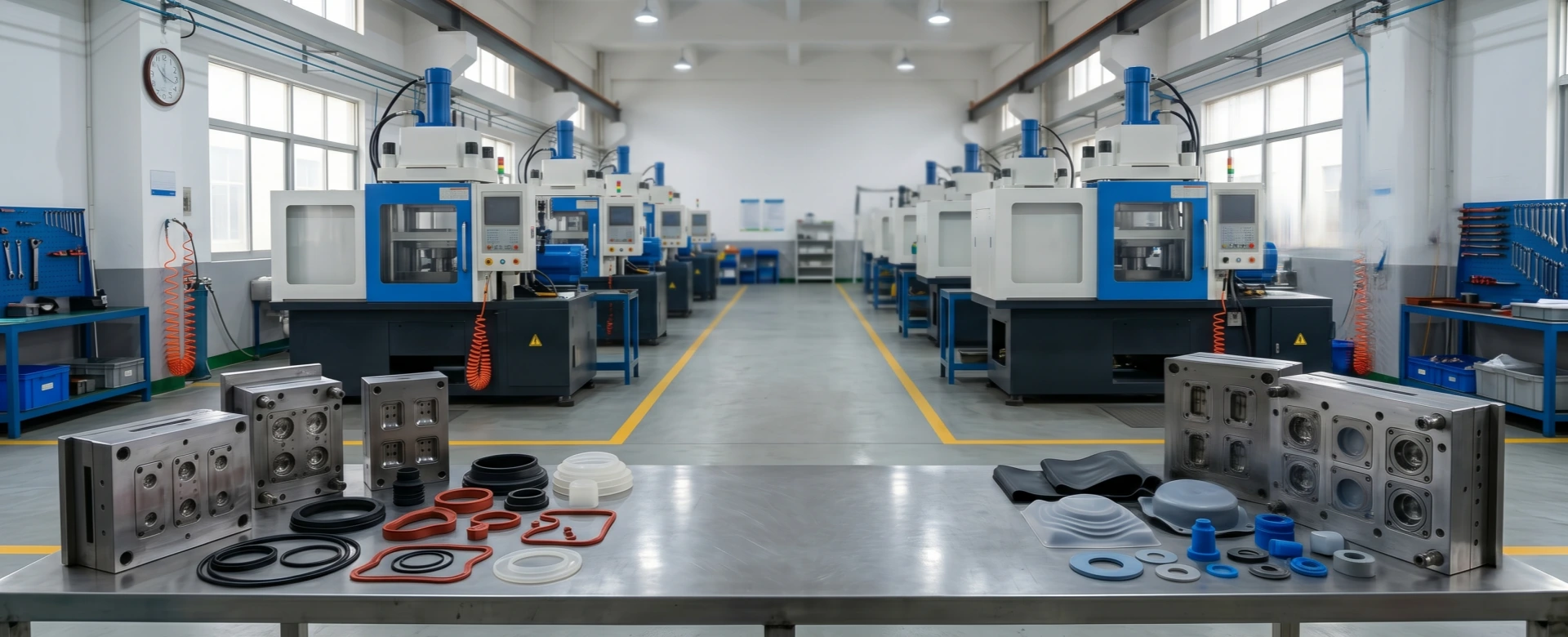
Whether utilizing Liquid Silicone Rubber injection molding or High-Temperature Vulcanized compression molding, initiating a production run requires extensive mechanical setup, thermal calibration, and raw material purging. These fixed preparatory costs remain identical whether the factory produces fifty units or fifty thousand units. This technical specification deconstructs the factory-floor cost structure, explaining the mechanical setup labor, machine opportunity costs, and mathematical amortization that dictate minimum production volumes in custom elastomer manufacturing.
Manufacturing Economics Axiom: The cost of the raw silicone material in a small production run is statistically insignificant. The customer is primarily paying for the exclusive monopolization of a massive industrial machine and the highly skilled engineering labor required to calibrate it.
1. The Mathematics of Fixed Cost Amortization
The pricing model for any custom molded silicone part is divided into fixed costs (which do not change based on volume) and variable costs (which scale directly with volume). The unit price of a single silicone component is determined by the following economic formula:
If the mechanical setup of a massive injection molding press requires three hundred dollars in engineering labor and machine time, amortizing that cost over an order of one hundred parts adds three dollars to the cost of every single part. If that same setup cost is amortized over a minimum order quantity of ten thousand parts, the setup burden drops to three cents per part. Manufacturers enforce minimum volumes to ensure the final unit price remains economically viable and competitive for the Original Equipment Manufacturer.
2. Mechanical Setup and Thermal Calibration
Initiating a new silicone production run is a labor-intensive engineering protocol. First, the heavy steel tooling (often weighing hundreds of kilograms) must be extracted from the storage warehouse, hoisted by overhead cranes, and bolted into the hydraulic platens of the molding press. Next, the tool must be slowly heated to precise vulcanization temperatures (typically between one hundred and sixty degrees Celsius and two hundred degrees Celsius). Heating a massive block of steel uniformly takes several hours.
Once the mold reaches the optimal thermal threshold, engineers must dial in the injection pressure, vacuum degassing duration, and curing time. The first several dozen parts produced during this calibration phase are automatically discarded as scrap while the engineers fine-tune the parameters to eliminate air traps and non-fill defects. This entirely consumes half a working shift before a single usable product is ever packaged.
3. Material Purging and Cross-Contamination
In Liquid Silicone Rubber manufacturing, changing the color or the hardness durometer requires flushing the entire pumping system. The delivery hoses, static mixing blocks, and injection barrels must be completely purged of the previous silicone compound to prevent pigment streaking or chemical cross-contamination.
This purging process inevitably wastes several kilograms of highly expensive, medical-grade raw silicone. If a customer only orders fifty units of a custom-colored component, the amount of raw material wasted during the pipeline purge will vastly exceed the amount of material actually injected into their finished products. The minimum order quantity ensures that the ratio of usable material to purged waste remains environmentally and economically sustainable.
4. Manufacturing Cost Comparison: Low Volume versus High Volume
| Economic Variable | Low Volume Run (Five Hundred Units) | Medium Volume Run (Five Thousand Units) | High Volume Run (Fifty Thousand Units) |
|---|---|---|---|
| Setup Cost Amortization | Extreme (Dominates the unit price) | Moderate (Balanced distribution) | Negligible (Approaches zero) |
| Purge Waste Ratio | High (Waste exceeds product) | Low (Economically viable) | Optimal (Maximum material efficiency) |
| Machine Opportunity Cost | Severe (Factory loses revenue) | Profitable (Standard production shift) | Ideal (Continuous automated running) |
5. Machine Allocation and Opportunity Cost
The final factor driving minimum order quantities is the concept of machine opportunity cost. An industrial molding press running a custom component cannot simultaneously produce anything else. If a client insists on a production run of just one hundred parts, the machine will be tied up for four hours (three and a half hours of setup and teardown, and thirty minutes of actual injection time).
During those same four hours, that exact machine could have been producing fifty thousand medical seals for another client. To protect their operational profitability, custom molding factories must set minimum volume thresholds that ensure the revenue generated from the production run justifies removing that piece of heavy machinery from the open schedule. By understanding these mechanical and economic realities, procurement teams can strategically design their supply chains to align with high-volume, low-cost continuous manufacturing models.
Scale Your Manufacturing Economics with Reemane Precision Molding
Optimize your procurement strategy, minimize setup cost amortization, and ensure absolute commercial viability across your entire product life cycle. Reemane provides full Design for Manufacturability audits, transparent cost breakdown structures, and scalable automated production lines. To coordinate an economic supply review, contact our production engineering desk at sales@siliconefactories.com or inspect our continuous manufacturing facility at www.siliconefactories.com.