 Silicone Manufacturer for Custom Silicone Products
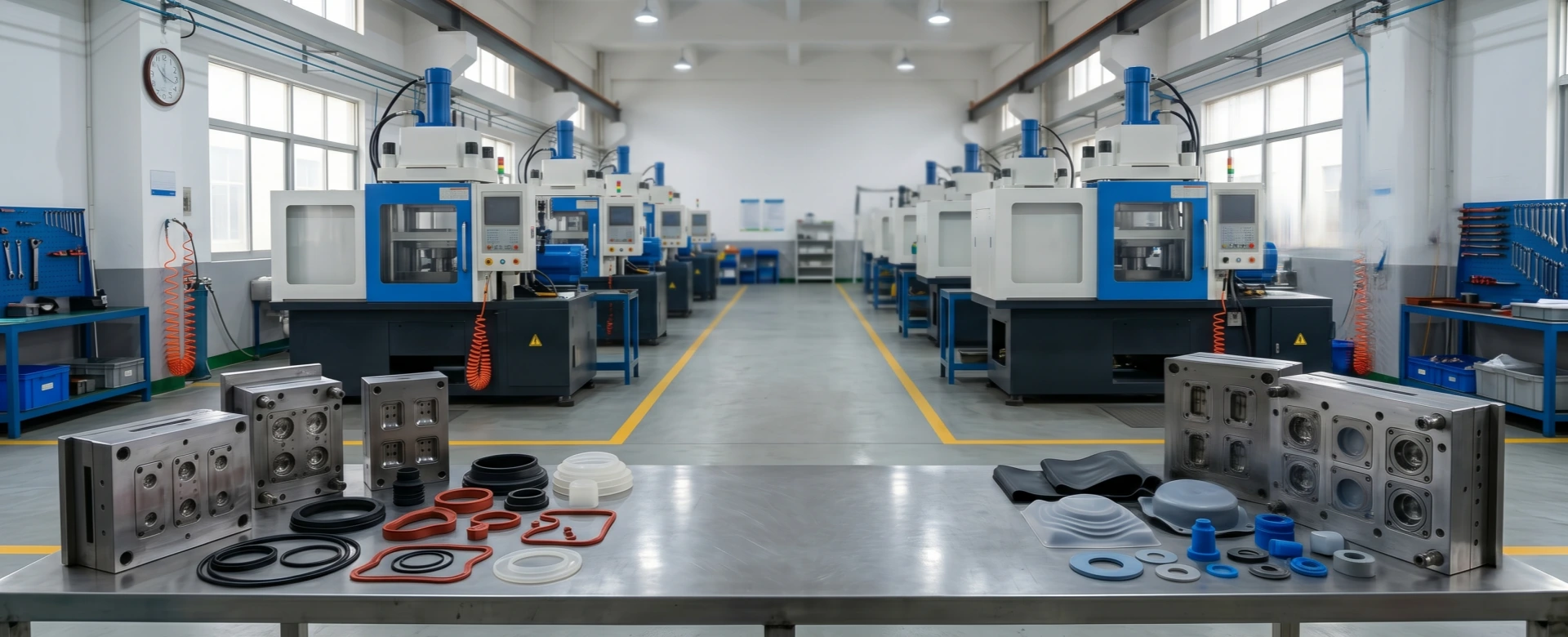
Cold Runner Systems in LSR Molding: Eliminating Material Waste and Optimizing Cycle Efficiency
In high-volume Liquid Silicone Rubber (LSR) injection molding, managing material scrap is the primary factor determining part cost and production sustainability. Sourcing teams accustomed to thermoplastic injection workflows often overlook the financial impact of runner scrap. Thermoplastics use hot runners or regrind mechanisms to melt and reuse waste material. However, LSR is a thermosetting polymer that undergoes an irreversible chemical cross-linking reaction when heated.
Once a platinum-catalyzed liquid silicone compound cures inside a standard molding channel, it turns into a permanent solid that cannot be melted down or recycled. In standard open-runner molds, this cured runner material—known as a cull pad or sprue scrap—is ejected as waste during every cycle. For small components like micro-valves, electronic seals, or medical gaskets, the mass of this wasted runner often exceeds the weight of the actual finished parts. Implementing an advanced, water-cooled LSR cold runner system resolves this inefficiency by keeping the material unvulcanized within the delivery channels, achieving zero-waste mass production.
1. Thermodynamic Mechanics: Maintaining a Mismatched Temperature Interface
The core mechanism of an LSR cold runner system relies on maintaining a strict temperature differential across a minimal physical gap inside the tool block. Liquid silicone cross-linking is temperature-dependent. The compound remains a pumpable, low-viscosity liquid at room temperature but cures almost instantly when exposed to temperatures between $165^{\circ}C$ and $200^{\circ}C$.
To control this behavior, a cold runner tool divides the mold into two distinct thermal zones separated by specialized polyimide insulating gaps. The cold runner manifold block features internal water-cooling jackets that maintain the compound at a steady $15^{\circ}C$ to $25^{\circ}C$, keeping the silicone liquid across indefinite cycle times. Directly below this interface, the main cavity plates are wrapped in high-output electric cartridge heaters maintaining a uniform $175^{\circ}C$ to $195^{\circ}C$. Managing this sharp thermal transition requires precise insulation design to prevent the heated plates from warming the cooling channels, which can cause premature vulcanization and plug the lines.
2. Structural Configurations: Valve Gated vs. Open Flow Cold Runner Networks
When engineering an LSR cold runner tool layout, designers select between two primary configurations depending on the target part geometry, cosmetic specifications, and total lifecycle budget limits.
LSR Cold Runner Technology Selection Matrix
| Tooling Metric | Open Flow (Cold Tip) Systems | Valve Gated Needle Systems | Conventional Hot/Warm Run |
|---|---|---|---|
| Scrap Reduction Rate | Moderate (Saves manifold, leaves micro-vestige) | Absolute 100% Zero-Waste (Flashless) | 0% (Full runner weight discarded) |
| Gate Vestige Quality | 0.3mm to 0.8mm protruding nib | Perfect Flush / Sub-surface indent | Variable heavy post-gate scarring |
| Cavity Pressure Control | Dependent on system barrel limits | Independent per-cavity needle shut-off | Imbalanced radial pressure degradation |
| Initial Capital CapEx | Baseline standard investment | Premium (Requires pneumatic actuation logic) | Low initial tooling expense |
3. Fluid Dynamics & Valve Gated Needle Mechanism Integration
For high-volume B2B manufacturing programs, a valve-gated cold runner network represents the highest level of LSR tool optimization. In this design, independent steel shut-off needles are nested inside each cooling nozzle. These needles are actuated by integrated pneumatic or hydraulic cylinders built into the top plate of the mold structure.
During the injection phase, the molding machine press signals the cylinders to retract the needles, allowing the pressurized liquid silicone to flow into the heated cavities. The moment the cavities reach optimal packing density, the cylinders drive the needles forward, sealing the gate flush with the cavity wall. This mechanical shut-off prevents material backflow and ensures that only the material inside the cavity vulcanizes, yielding a completely flashless part with a clean gate vestige.
4. Economic Amortization and Material Cost Savings Analysis
From a procurement perspective, the higher upfront cost of a valve-gated cold runner tool is easily justified by modeling the material cost savings over a long-run project lifecycle. For example, consider a 16-cavity medical check-valve component manufactured from medical-grade liquid silicone costing $12.50 per kilogram. The part weight is 1.5 grams, and a standard open runner configuration generates an additional 18.0 grams of cured scrap material per machine cycle.
Open Runner Configuration Waste Calculation:
$\text{Material per shot} = (16 \times 1.5\text{g}) + 18.0\text{g (Scrap)} = 42.0\text{g}$
$\text{Scrap Percentage} = \frac{18.0\text{g}}{42.0\text{g}} = 42.8\%$
By switching to a valve-gated cold runner system, the 18.0 grams of runner scrap is completely eliminated, reducing the material required per shot to exactly 24.0 grams. Over a 1,000,000-unit production run, this optimization eliminates 1,125 kilograms of cured silicone waste, saving $14,062.50 in raw material costs alone while significantly reducing machine cycle times.
5. DFM Tooling Rules for Advanced LSR Cold Runner Integration
To ensure consistent quality and process control when integrating an LSR cold runner system, tool designs must follow key guidelines during initial engineering reviews:
- Balanced Cooling Manifold Geometry: Water-cooling channels must wrap evenly around all distribution blocks to eliminate localized hot spots, keeping the liquid silicone compound at a uniform temperature before cavity entry.
- Nozzle Tip Thermal Separation: Nozzle tips must incorporate high-performance insulation seals (such as custom PEEK caps) where they interface with the heated cavity plates, preventing thermal bleed and gate freezing.
- De-molding Optimization: Parting lines and ejection mechanisms must be designed for automatic part removal using vacuum suction cups or air-blast plates, maximizing the cycle efficiency advantages of the runnerless design.
Maximize Efficiency on Your High-Volume LSR Production Lines
Eliminate costly thermoset material scrap, reduce cure cycle overheads, and secure perfect gate cosmetics using advanced valve-gated cold runner technology. Reemane provides full capital amortization reports, verified runnerless DFM tool layouts, and integrated needle stroke calibration parameters.