 Silicone Manufacturer for Custom Silicone Products
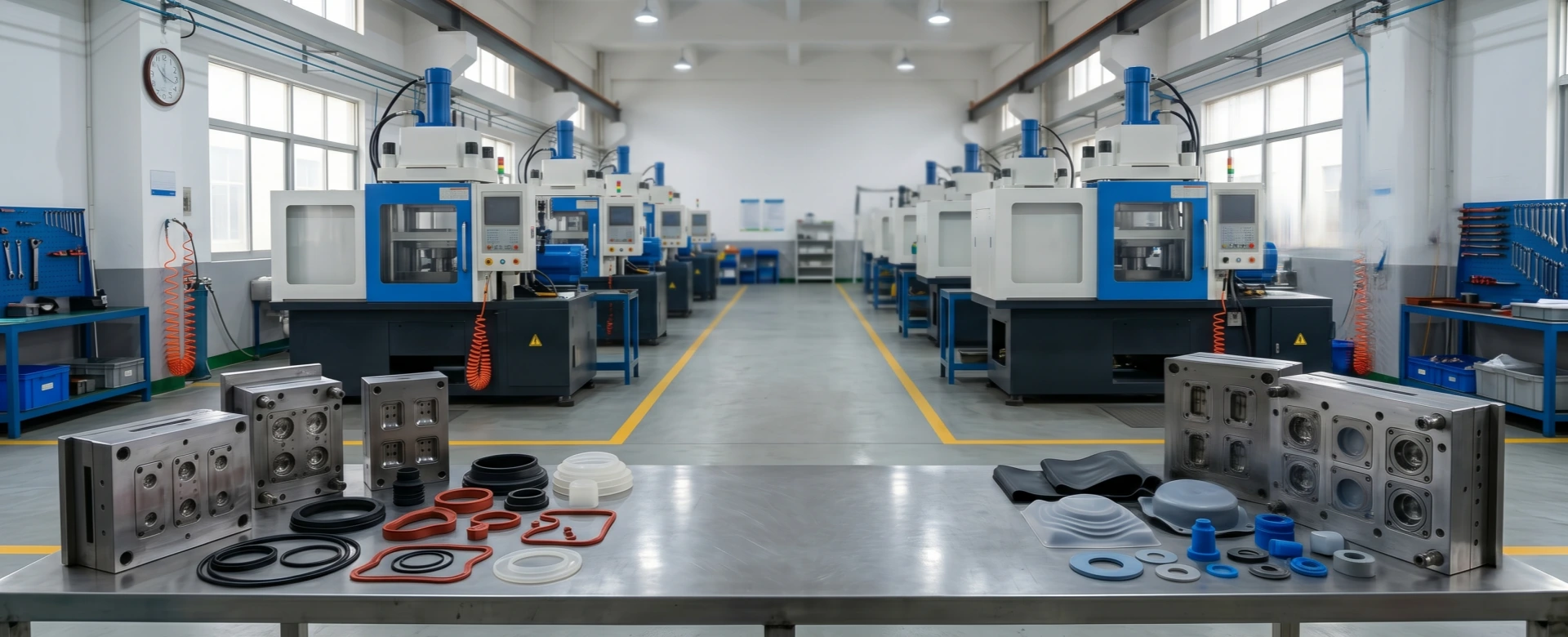
Direct answer:
Compression molding is often the best choice for low-volume silicone production when a project needs a real molded silicone part and dedicated tooling, but the expected demand does not justify a highly automated liquid silicone injection system.
It is especially practical for prototype-to-production programs, custom industrial parts, replacement components, multiple sizes or colors, recurring small batches, and products whose geometry can be loaded, cured, demolded, trimmed, and inspected efficiently. Low volume is not one fixed quantity; the correct process depends on part size, mold structure, cavity count, cycle time, labor, quality requirements, and expected repeat orders.
Buyers sometimes assume that a small order should always use the cheapest temporary process, or that compression molding is only suitable for very large production runs. Neither assumption is reliable.
A custom silicone component may require a production mold even when the first order is only a few hundred pieces. The mold may be necessary to create the required shape, wall thickness, sealing surface, undercut, texture, dimensional consistency, or assembly fit. In other cases, a very small order may be more economical through die cutting, precision cutting, machining, joined cord, or a temporary prototype route.
The purpose of a low volume silicone compression molding review is therefore not to ask whether the order is simply “small.” The real question is whether compression molding provides the best balance of tooling investment, product performance, unit cost, development risk, repeatability, and future production capacity.
Reemane supports custom silicone compression molding projects from drawing or sample review through mold development, prototype sampling, low-volume production, and repeat manufacturing. We can evaluate the product structure, expected demand, material and hardness direction, mold concept, sampling plan, and information required for quotation.
Low-Volume Process Decision at a Glance
Project Requirement → Geometry and Material Review → Expected Order Pattern → Tooling and Cavity Plan → Prototype Sampling → First Small Batch → Repeat Production
What Does Low-Volume Silicone Production Mean?
There is no universal quantity that defines low-volume silicone production. The meaning changes according to the product.
A few hundred small washers may represent limited press time and material usage. The same quantity of large protective boots, thick equipment covers, or multi-core molded components may require significant mold capacity, silicone material, curing time, manual handling, trimming, and inspection.
The following factors are more useful than one fixed quantity:
- Finished part size and silicone weight
- Number of parts produced in each mold cycle
- Cycle time and cure time
- Manual loading and demolding requirements
- Trimming, post-curing, printing, assembly, and packaging
- Inspection and functional-testing requirements
- Whether the order is one-time or recurring
- Estimated annual demand
- Number of sizes, colors, hardness levels, or related SKUs
- Likelihood that the product design will change after sampling
A recurring order of several hundred pieces may justify proper production tooling more easily than a one-time order of the same quantity. The mold can continue supporting repeat batches, reducing the need to redesign the process each time the customer reorders.
Buyer takeaway:
Do not evaluate the process only by the first purchase order. Consider the complete product life, annual usage, expected repeat orders, and the cost of an unsuccessful first production route.
Why Compression Molding Can Work Well for Low-Volume Silicone Parts
Lower Entry Barrier Than a Highly Automated Production System
Compression molding uses prepared solid silicone charges that are placed into a heated mold and cured under pressure. The process can be configured with a practical number of cavities and a level of manual operation appropriate for the expected order volume.
This can reduce the need to invest immediately in a more complex automated feeding, injection, and mold system when the annual demand is still limited or uncertain.
Lower initial investment does not mean that the mold can be poorly designed. The tooling must still control shrinkage, cavity filling, air release, parting lines, flash, curing, demolding, and the dimensions required by the application.
Suitable for Prototype-to-Production Development
Many custom silicone projects begin with uncertain demand. The customer first needs samples to confirm fit, sealing, grip, protection, appearance, or assembly. Only after the product passes validation can the buyer estimate real production demand.
Compression molding can support this development path:
- Review the product structure and application.
- Develop a mold appropriate for the expected program.
- Produce prototype or development samples.
- Adjust the mold or process after sample feedback when practical.
- Produce the first approved small batch.
- Continue with repeat orders after market or equipment validation.
This is particularly useful for B2B projects where the silicone component must be tested inside an actual machine, enclosure, tool, device, handle, groove, or assembly before the customer commits to larger quantities.
Flexible for Multiple Sizes, Colors, and Hardness Levels
Some customers do not need one product in one very large quantity. They need several related parts, such as:
- Different ring or gasket sizes
- Protective covers for several equipment models
- Several colors for brand or assembly identification
- Different Shore A hardness levels for testing
- Regional packaging or labeling variants
- Industrial spare parts ordered according to maintenance demand
Compression molding can provide a practical production route when each individual SKU does not justify a high-output automated system, but the customer still needs true molded silicone geometry and stable repeat manufacturing.
Practical for Large, Thick, or Relatively Simple Molded Parts
Large or thick solid silicone parts can consume substantial material and mold space even when the piece quantity is limited. Examples may include:
- Equipment covers and protective boots
- Large seals and custom gaskets
- Thick pads, cushions, supports, and bumpers
- Industrial caps and plugs
- Custom housings and sleeves
- Replacement parts for machinery or electrical equipment
When the geometry can be loaded and demolded efficiently, compression molding can be more practical than developing an automated injection system for a relatively small annual requirement.
Supports Repeat Small-Batch Ordering
Some customers deliberately avoid purchasing a full year of inventory at once. They may prefer smaller scheduled releases because:
- Demand is project-based or seasonal.
- The silicone part is used as a spare or maintenance component.
- The buyer wants to reduce inventory and cash-flow pressure.
- Several product revisions are still being tested.
- Color, packaging, or labeling may change between batches.
- The final product is being launched in stages.
A stable compression mold can support these repeat orders without requiring the customer to purchase an unnecessarily large first batch.
What Determines the Tooling Cost?
A low production quantity does not automatically mean that the mold is simple. Tooling cost is primarily controlled by the product structure and the production plan.
Important tooling factors include:
- Overall product size
- Number of mold cavities
- Parting-line position
- Undercuts and removable cores
- Deep cavities or long internal cores
- Thin lips, membranes, or sealing edges
- Insert molding or overmolding requirements
- Surface texture and cosmetic requirements
- Flash-control and venting requirements
- Critical dimensions and tolerance expectations
- Expected mold life and repeat production volume
A one-cavity mold may reduce initial tooling investment, but it can increase unit cost and production time. A multi-cavity mold may reduce unit cost, but it requires a larger initial investment and may be unnecessary if annual demand remains limited.
The correct cavity quantity should therefore be selected according to:
- First-order quantity
- Estimated annual usage
- Expected reorder frequency
- Required delivery time
- Part size and press capacity
- Loading and demolding difficulty
- Available project budget
Reemane can review these points during
silicone mold development
before the tooling and sample plan is confirmed.
What Determines the Unit Price?
Raw silicone weight is only one part of the unit price. The complete production cycle and the work required after molding must also be included.
Silicone Material and Part Weight
Material grade, hardness, color, cure system, finished part weight, process waste, and any post-curing requirement influence material cost.
Parts Produced per Mold Cycle
A mold that produces one part per cycle will normally have a different cost structure from a mold that produces eight or sixteen parts per cycle. Cavity quantity must be balanced against tooling investment and expected demand.
Loading, Curing, and Demolding Time
The complete press cycle includes preform preparation, mold loading, closing, venting, curing, opening, demolding, and preparing the mold for the next cycle. Thick parts, difficult undercuts, removable cores, or delicate features can reduce production output.
Trimming and Secondary Operations
A product may require:
- Flash trimming
- Hole opening
- Cleaning
- Post-curing
- Printing or marking
- Assembly with another component
- Individual packaging
- Special protection against deformation or contamination
For some low-volume products, these manual operations cost more than the direct press cycle.
Inspection and Functional Testing
Tight dimensional inspection, cosmetic sorting, leak testing, fit testing, electrical testing, documentation, traceability, or special reporting can significantly affect the unit price.
Important:
A small and lightweight silicone part can still have a relatively high unit price if it requires a complex mold, slow demolding, manual trimming, tight tolerances, or extensive inspection.
Compression Molding vs. Liquid Silicone Injection Molding
Both processes can manufacture silicone components, but they have different investment and production characteristics.
Compression Molding Is Often More Suitable When
- The project uses solid high-consistency silicone rubber.
- Annual demand is limited or uncertain.
- The product is in prototype or early production stages.
- The customer needs repeat small batches.
- The part is large, thick, or relatively straightforward to load and demold.
- Several sizes, colors, or hardness variants are required.
- A lower initial tooling burden is more important than maximum automation.
Liquid Silicone Injection Molding May Be More Suitable When
- Demand is high, stable, and expected to continue for a long period.
- High automation and short production cycles can recover the larger tooling investment.
- The geometry is suitable for liquid silicone injection.
- The project requires a highly automated feeding and molding process.
- Labor reduction and high-output repeatability are major commercial priorities.
The decision should not be based only on the first mold quotation. A higher initial tooling investment may become economical at large and stable volumes, while compression molding may provide a lower-risk entry route when demand is limited.
Compression Molding vs. Other Low-Volume Production Options
Die Cutting
Die cutting may be more economical for very small quantities of flat washers, flat gaskets, and sheet-style components with a consistent thickness. It cannot reproduce every three-dimensional molded feature.
Precision Cutting or Machining
Precision cutting may support prototypes, low quantities, large rings, or special profiles when suitable silicone stock is available. Surface condition, dimensional capability, material waste, and repeat production cost must be reviewed.
Joined Silicone Cord or Strip
Joined construction may be considered for very large replacement seals or limited maintenance quantities. The joint becomes a critical feature and may not provide the same performance as a continuous molded part.
Existing Mold or Standard Product
If a suitable existing mold or standard part already meets the functional requirements, using it may avoid unnecessary custom tooling. However, the customer should verify dimensions, material, hardness, color, function, and long-term availability rather than selecting only by appearance.
When Compression Molding May Not Be the Best Choice
Compression molding should not be selected automatically for every low-quantity silicone part.
Another process may be more suitable when:
- The quantity is so small that production tooling cannot be justified.
- The part is a simple flat shape that can be die cut from sheet.
- A standard available product already meets the requirements.
- The geometry requires extremely small features or a specialized automated process.
- The expected volume is high and stable enough to justify a more automated system.
- The selected compression-molding route cannot meet the required tolerance, cleanliness, testing, or process-control requirements.
- The customer expects a very low unit price without considering mold, labor, trimming, inspection, and batch size.
The correct choice is the process that meets the functional and quality requirements at the lowest total program risk.
Typical Low-Volume Silicone Compression Molding Projects
Projects that may fit this production route include:
- Custom industrial seals and gaskets
- Replacement O-rings and square-section rings
- Protective covers for tools, equipment, and devices
- Custom handle sleeves and grip covers
- Caps, plugs, dust covers, and protective closures
- Grommets, bushings, cable-routing parts, and pass-through components
- Shock-absorbing pads, bumpers, cushions, and supports
- Custom boots and flexible housings
- Equipment maintenance and legacy replacement components
- New branded consumer products requiring market validation
- Several related products with limited demand per SKU
Explore Reemane’s
custom silicone rubber parts
and
silicone compression molding services
for industrial and OEM projects.
DFM Questions to Resolve Before Tooling
A low-volume program still requires proper design-for-manufacturing review. Before building the mold, confirm:
- Where can the mold parting line be located?
- Can the product be demolded without tearing or permanent deformation?
- Are undercuts or removable cores required?
- Which dimensions control fit, sealing, grip, retention, or assembly?
- Are all specified tolerances functionally necessary?
- Which surfaces are cosmetic or customer-visible?
- How many cavities are appropriate for the expected annual demand?
- Will the design change after the first sample?
- How will the product be inspected and functionally tested?
- What packaging prevents deformation, contamination, or incorrect counting?
The mold should be designed for the likely life of the product rather than only the first purchase order. If the customer expects demand to increase, the mold concept should balance current budget with future capacity.
How Reemane Supports Low-Volume Silicone Projects
Reemane supports custom silicone projects that begin with complete CAD files as well as projects that begin from a physical sample, product photographs, dimensions, or an early concept.
Our project workflow can include:
- Requirement review based on drawings, samples, or product ideas
- Compression-molding feasibility evaluation
- Material and Shore A hardness discussion
- Parting-line and demolding review
- Custom silicone mold development
- Prototype and development samples
- Mold or process adjustment based on sample feedback
- First low-volume production batch
- Repeat-order and capacity review
- Custom color, logo, surface, packaging, and labeling support
Learn more about our
silicone mold development
and
OEM and ODM silicone manufacturing support
.
Information Needed for a Reliable Low-Volume Quote
- STEP file, 2D drawing, physical sample, or clear product photographs
- Part dimensions and critical tolerances
- Mating-part, groove, housing, or assembly information
- Target silicone material, Shore A hardness, color, and surface requirements
- Operating temperature, contact media, cleaning method, and outdoor exposure
- Required sealing, grip, fit, cushioning, protection, insulation, or retention function
- Prototype quantity and first production quantity
- Estimated annual usage and expected reorder frequency
- Testing, inspection, documentation, packaging, and labeling requirements
- Target schedule and current design status
- Any current product failure or supplier problem
Planning a Low-Volume Custom Silicone Part?
Send Reemane your drawing, sample, dimensions, application conditions, prototype quantity, first production quantity, and expected annual demand. We will review whether compression molding is a practical route and identify the next step for tooling, sampling, and quotation.
Download the Reemane Technical Guide
Save, share, or forward the engineering version of this article:
Low-Volume Silicone Compression Molding Guide,
published by Shenzhen Reemane Silicone Technology Co., Ltd.
Frequently Asked Questions
Is compression molding suitable for only a few hundred silicone parts?
It can be, depending on product size, geometry, tooling complexity, first-order value, annual demand, and whether repeat orders are expected. A custom molded part may require production tooling even when the initial quantity is limited.
What is the minimum order quantity for compression-molded silicone parts?
There is no universal MOQ for every custom part. The practical quantity depends on mold setup, cavity count, material preparation, curing, trimming, inspection, packaging, and the commercial value of the project. Reemane reviews MOQ according to the actual product.
Is the cheapest mold always best for low-volume production?
No. A very simple low-cost mold may produce too few parts per cycle, require excessive manual labor, or be difficult to adjust and maintain. The mold should balance initial investment, sample approval, unit cost, delivery requirements, and expected repeat demand.
Can Reemane make prototype samples before a larger order?
Yes. Prototype or development samples can be produced after mold development so the customer can review dimensions, fit, function, appearance, material direction, and assembly before mass production.
Can a low-volume mold later support larger quantities?
Sometimes. This depends on mold material, cavity quantity, cycle time, part size, quality requirements, and future demand. Expected annual usage should be discussed before tooling so the mold is not designed only around the first small order.
When is die cutting better than compression molding?
Die cutting may be more economical for very small quantities of simple flat washers and gasket-style components made from silicone sheet. Compression molding is more suitable when the part requires a three-dimensional profile, molded details, controlled edges, undercuts, or a custom solid shape.
What information is required for a low-volume silicone quotation?
Send the drawing or sample, product dimensions, material and hardness direction, application conditions, prototype quantity, first production quantity, estimated annual usage, inspection requirements, packaging needs, and expected reorder pattern.
Can Reemane review a project before the design is finalized?
Yes. An early review can begin with sketches, photographs, basic dimensions, a physical sample, or an explanation of the required function. Accurate mold quotation normally follows after the structure and critical dimensions are sufficiently defined.