 Silicone Manufacturer for Custom Silicone Products
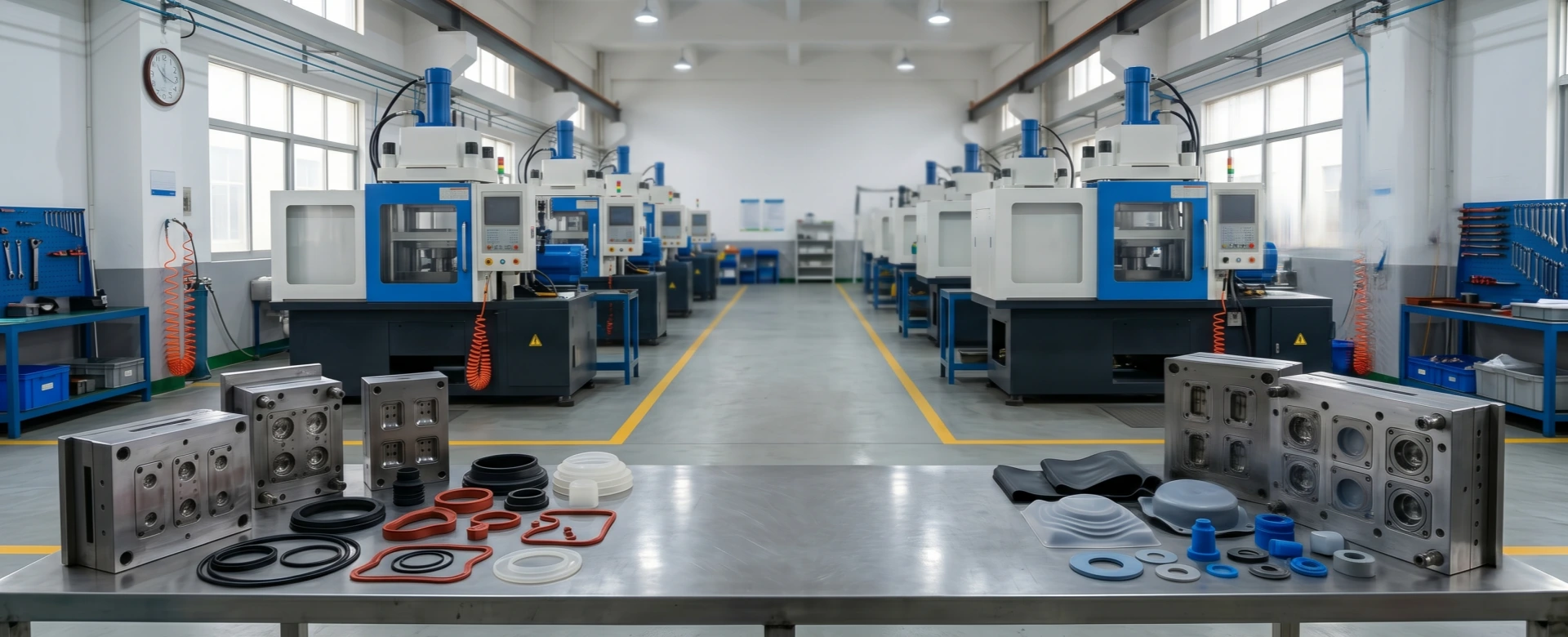
Cleanroom Silicone Molding: Requirements for ISO Class 7 and Class 8 Controlled Environments
In the production of medical device components, biopharmaceutical processing components, infant care products, and micro-optical lenses, environmental contamination poses a severe risk to product safety. Standard heavy industrial manufacturing floors are filled with airborne micro-particulates, suspended oil aerosols, and ambient microbial counts. If a platinum-cured liquid silicone rubber (LSR) component captures these microscopic foreign particles during its high-heat vulcanization phase, the contaminant becomes permanently fused inside the elastic matrix.
For medical implants or fluid-path components, these embedded impurities compromise bio-compatibility, trigger severe foreign-body reactions in patients, and act as structural weak points that can lead to early component tearing under dynamic pressure. Mitigating this risk requires migrating operations into certified, positive-pressure controlled environments governed by the ISO 14644-1 framework.
1. Cleanroom Classification Matrix: ISO Class 7 vs. ISO Class 8
The operational divide between ISO Class 7 (legacy Class 10,000) and ISO Class 8 (legacy Class 100,000) environments is defined by the maximum allowable concentration of airborne particulates per cubic meter of atmospheric space. Managing these limits requires customized Heating, Ventilation, and Air Conditioning (HVAC) systems equipped with High-Efficiency Particulate Air (HEPA) filters operating under high room air change frequencies.
ISO Class 8 structures serve as the baseline setup for primary compounding, component post-baking ovens, and initial material staging bays. ISO Class 7 spaces enforce a ten-fold reduction in permitted particulate volume fractions, acting as the strict environment for liquid injection molding (LIM) machine clamping zones, automated de-molding operations, clean packaging steps, and precision visual sorting lines.
ISO 14644-1 Environmental Performance Benchmarks
| Cleanroom Class | Max Particles (≥ 0.5 μm / m³) | Max Particles (≥ 5.0 μm / m³) | Air Change Rate | Pressure Status |
|---|---|---|---|---|
| ISO Class 7 | 352,000 | 2,930 | 30 – 60 / Hour | ≥ +15 Pa |
| ISO Class 8 | 3,520,000 | 29,300 | 15 – 25 / Hour | ≥ +10 Pa |
2. Operational Infrastructure for Injection Molding Systems
Operating a high-tonnage silicone injection molding press inside a highly sensitive cleanroom structure introduces complex mechanical engineering challenges. Standard industrial hydraulic clamping systems present constant threats via outgassing hydraulic fluid misters, escaping bearing grease, and metallic frictional wear particles. To protect the cleanroom environment, Reemane implements precise machine modification protocols.
First, all hydraulic systems are completely barred from the molding zone, utilizing instead fully electric injection molding systems with sealed servo drives. Second, when partial hydraulic systems are required for high-tonnage compression clamping setups, the machine configuration is split: the mechanical hydraulic pump assembly and control panels are isolated behind a physical partition wall outside the cleanroom boundary, while only the clean, stainless-steel tie-bar clamping platens extend through an airtight interface into the clean room envelope.
3. Advanced Post-Curing Handing & Bioburden Vector Control
Vulcanized components exiting the mold tooling must pass through specific secondary processing paths to eliminate bioburden contamination vectors. Human operators constitute the single largest source of particulate shedding inside a cleanroom environment via skin flakes and clothing fibers. Reemane addresses this challenge by integrating automated robotic pick-and-place end-effectors to handle components directly from the mold face, minimizing human contact paths.
Following demolding, medical-grade components undergo continuous post-vulcanization baking (post-curing) inside sealed, cleanroom-compliant forced-air ovens at 200°C for 4 hours. This sequence removes volatile low-molecular-weight siloxanes (D4, D5, and D6 cyclosiloxanes), ensuring compliance with strict FDA and European LFGB extractable regulatory limits. After post-curing, parts pass through inline multi-stage ultrasonic washing systems using ultra-pure deionized water, followed by immediate dual-layer anti-static cleanroom heat sealing within the ISO Class 7 zone.
4. DFM Frameworks for Cleanroom-Compliant Hard Tooling
To support high-volume cleanroom manufacturing, product layouts and core mold tooling must incorporate specific Design for Manufacturing (DFM) rules during initial engineering reviews. Standard tool steels like P20 are unacceptable due to oxidation risks during high-humidity sanitization cycles. Cleanroom molds are cut from high-purity, corrosion-resistant stainless-steel alloys, specifically hardened S136 tool steel polished to an SPI-A1 diamond mirror grade to facilitate effortless, lubricant-free part release.
Additionally, conventional petroleum-based mold release sprays are strictly prohibited because they immediately atomize into sticky airborne aerosols that clog HEPA filters and contaminate nearby parts. Mold tool geometry must integrate generous draft angles (ranging from 2° to 5°) alongside integrated mechanical core pulls or non-marking pneumatic air-ejection poppets to reliably cycle parts without chemical release agents.
Secure Certified Cleanroom Sourcing Integrity
Eliminate microscopic particle inclusions, manage rigid bioburden validation metrics, and secure certified ISO Class 7 and Class 8 medical-grade component execution for your critical device lines. Reemane provides comprehensive material test sheets, validation records, and full cleanroom tool processing analytics.