 Silicone Manufacturer for Custom Silicone Products
Automotive Silicone Spark Plug Boots and High-Tension Ignition Wires: Resisting High Voltage
Modern internal combustion engines, particularly high-efficiency downsized turbocharged systems and high-performance racing platforms, place severe thermal and electrical stresses on high-tension (HT) ignition infrastructure. The ignition network must deliver high-voltage spikes ranging from 30 kV to 50 kV from the ignition coils to the spark plugs without experiencing dielectric breakdown, surface tracking, or structural leakage.
Simultaneously, these components operate in harsh environments directly adjacent to exhaust manifolds, where localized under-hood temperatures frequently spike up to 250°C, and down to -40°C during arctic cold starts. To maintain structural integrity and suppress electromagnetic interference (EMI) without early dielectric failure, Tier-1 automotive sourcing groups rely on specialized High-Consistency Silicone Rubber (HCR) and Liquid Silicone Rubber (LSR) matrices. This report maps out the core material parameters, geometric defect controls, and validation frameworks required to manufacture high-voltage automotive insulation components.
1. Polymer Physics: The Siloxane Shield Against Dielectric Breakdown
Under continuous high-voltage fields, standard organic elastomers like EPDM suffer from localized electrical tracking and corona discharge degradation. Corona discharges generate high concentrations of atmospheric ozone ($O_3$), which attacks the carbon-carbon ($\text{C-C}$) unsaturation links in organic rubber backbones, causing micro-fissures, hardening, and subsequent voltage arc-through failures.
Silicone rubber utilizes an inorganic polysiloxane backbone consisting of repeating silicon-oxygen ($\text{Si-O-Si}$) linkages. The substantial bond energy of the siloxane structure ($445\text{ kJ/mol}$) prevents molecular cleavage under standard corona radiation fields. Furthermore, premium automotive silicone formulations achieve a baseline dielectric strength exceeding 20 kV/mm to 25 kV/mm when measured under ASTM D149 protocols. This enables thin-walled spark plug boot profiles to isolate 40 kV ignition charges safely without requiring thick, heavy geometries that would interfere with tight engine cylinder head packaging configurations.
2. Geometric Optimization: Elimination of Internal Voids and Micro-Porosity
When engineering high-voltage insulation boots, component geometry and manufacturing consistency are as critical as the material formulation. The presence of tiny internal defects can trigger premature component breakdown via a mechanism known as Partial Discharge (PD):
- The Partial Discharge Pathway: If a spark plug boot contains a trapped microscopic air bubble (void) within its wall section during molding, the dielectric constant of that air gap ($\text{dielectric constant} \approx 1.0$) is significantly lower than that of the surrounding silicone matrix ($\text{dielectric constant} \approx 3.0$). Under high voltage, the electrical field strength concentrates inside the void, exceeding the breakdown strength of air and causing localized arcing inside the pocket.
- Thermal Tracking & Breakdown: These micro-arcs generate severe heat and erode the surrounding silicone, turning the cavity into a carbonized tracking channel that eventually leads to a complete voltage puncture and engine misfires.
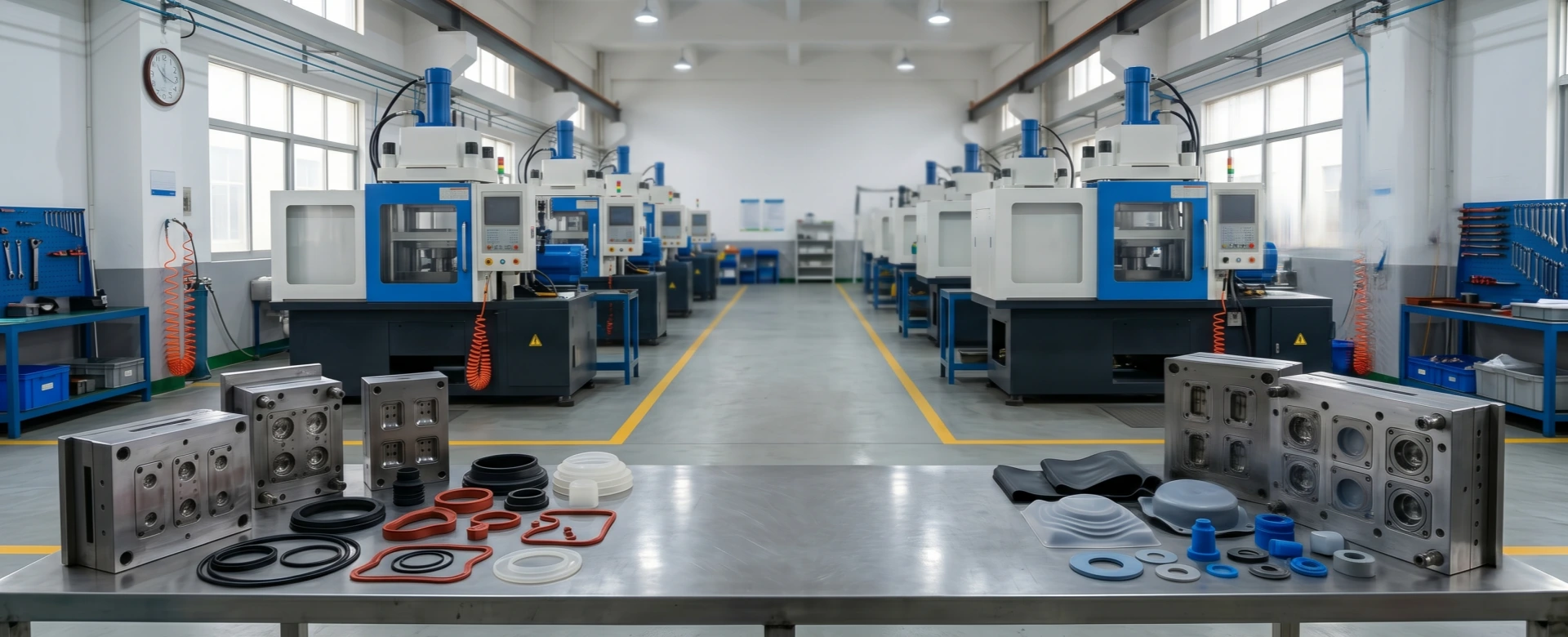
- Tooling Defect Mitigation: To eliminate internal porosity, Reemane utilizes high-pressure multi-cavity injection molding equipment paired with advanced vacuum-evacuation venting slots. Raw HCR or LSR formulations are degassed prior to injection, and the tool molds are clamped under high hydraulic force to guarantee zero micro-void formations along the critical insulation walls.
3. Multi-Layer Cable Architecture: High-Tension Ignition Wires
High-tension ignition wires utilize a multi-layer design to balance high electrical isolation with robust mechanical tension profiles. The core consists of a conductive graphite-saturated fiberglass or wire-wound ferromagnet matrix that suppresses EMI fields. This conductive core is directly surrounded by a thick primary insulation sleeve extruded from high-purity, high-dielectric HCR silicone.
To withstand mechanical pulling forces during routine engine maintenance, a high-density fiberglass braid reinforcement layer is wrapped over the inner silicone sleeve. Finally, a secondary outer protective jacket extruded from a highly tear-resistant, oil-tolerant silicone compound is applied. This multi-layer approach fulfills ISO 3808 Class F specifications, certifying continuous operational reliability at temperatures up to 220°C with peak excursions to 250°C, while preventing oil, fuel, and road salt splash ingress from compromising the inner electrical path.
4. Automotive Dielectric Insulation Selection Matrix
| Performance Attributes | High-Consistency Silicone (HCR) | Liquid Silicone Rubber (LSR) | Industrial EPDM Rubber |
|---|---|---|---|
| Dielectric Strength (ASTM D149) | Excellent (23–25 kV/mm) | Premium (25–28 kV/mm) | Moderate (15–18 kV/mm; degrades hot) |
| Continuous Temperature Limit | 220°C (Excursions up to 250°C) | 200°C (Excursions up to 230°C) | Fails at >130°C (Hardens and cracks) |
| Ozone & Corona Arc Resistance | Immune (No tracking degradation) | Immune (Superior surface finish) | Poor (Rapid micro-cracking under corona) |
5. Metrology and High-Potential (Hi-Pot) Batch Validation
To verify zero-defect shipments for automotive production runs, parts undergo high-potential validation testing. Reemane runs automated, inline Hi-Pot testing loops inside its quality testing facilities. Cured spark plug boots are mounted onto automated stainless steel grounding mandrels that mimic engine cylinder geometry.
An electrical probe inputs a continuous high-voltage charge of 35 kV AC at 50 Hz directly into the terminal core cavity for a fixed verification window. Downstream high-precision micro-ampere sensors monitor the ground line; any sudden current spike flags an internal void or insulation wall thin sector, automatically discarding the defective part via pneumatic sorting gates. This 100% automated inspection protocol guarantees zero field arc-through failures, helping global procurement groups minimize warranty risks and protect brand reputation.
Secure High-Voltage Ignition Reliability with Reemane Engineered Component Assets
Eliminate localized voltage leakage paths, eradicate under-hood corona micro-cracking failures, and maintain flawless insulation wall metrics under extreme thermal conditions. Reemane provides full multi-cavity vacuum-evacuated DFM tooling, inline automated 35 kV Hi-Pot decay sorting, and certified ISO 3808 Class F compliance validation reporting.