 Silicone Manufacturer for Custom Silicone Products
Silicone Grommets for Automotive Wire Harnesses: Preventing Mechanical Chafing and Water Ingress
Automotive Electrical Distribution Systems (EDS)—the intricate wire harness networks connecting core powertrain control modules, sensory arrays, and chassis computing architecture—must navigate raw structural transitions. The physical junctions where a multi-wire bundle passes through raw sheet-metal bulkheads, engine room firewalls, or exterior door pillars present immediate operational hazards. During vehicle motion, structural sub-frame vibration loops and structural acceleration harmonics subject bundles to relentless physical friction against sharp panel borders, causing mechanical insulation chafing, wire copper fracturing, and full short-circuit system failures.
Simultaneously, these body-panel pass-through boundaries act as primary ingress vectors for environmental elements. In modern vehicle architectures, wire harness grommets are located in regions heavily exposed to road splash, salt spray, mud accumulation, and aggressive high-pressure hot-water washdowns. To achieve a zero-leak seal that satisfies automotive warranty metrics, engineering and procurement teams must transition away from commodity elastomers. This comprehensive specification details the polymer kinetics, hyperelastic contact mechanics, tool tooling tolerances, and laboratory validation protocols required to design and source high-reliability automotive silicone pass-through grommets.
1. Polymer Kinetics: Why Silicone Outperforms EPDM under Class 4 Thermal Stresses
When selecting the base elastomer backbone for automotive wiring pass-throughs, the material’s degradation profile under long-term environmental stress dictates the vehicle’s field reliability. Traditional materials like ethylene propylene diene monomer (EPDM) or chloroprene possess a hydrocarbon-based macromolecular structure that degrades rapidly when exposed to high temperatures, atmospheric ozone, and under-hood fluids. Modern engine compartments place grommets directly adjacent to downsized turbochargers and exhaust gas recirculation (EGR) valves, pushing operating environments into USCAR-2 Class 4 thermal bands (-40°C to +150°C continuous, with transient spikes reaching +175°C).
Silicone rubber utilizes an inorganic polysiloxane backbone composed of repeating silicon-oxygen ($\text{Si-O-Si}$) links. The binding energy of a siloxane bond is approximately $445\text{ kJ/mol}$, significantly higher than the $348\text{ kJ/mol}$ carbon-carbon ($\text{C-C}$) binding threshold of EPDM. This atomic configuration makes premium silicone highly resistant to ultraviolet (UV) radiation fragmentation and high-intensity atmospheric ozone exposure. While EPDM hardens, loses its elastic memory, and develops deep micro-fissure structural cracks within 3 to 5 years of under-hood deployment, cross-linked silicone retains its structural compliance and sealing characteristics across a broad thermal range from -50°C to +200°C, matching the 20-year service lifecycle of the vehicle chassis.
2. Hyperelastic Contact Mechanics: Optimizing Radial Sealing Force and Gland DFM
To safeguard the shifting multi-wire bundle interface against water ingress under dynamic pressure, the internal passages of the silicone grommet must exert continuous, uniform radial contact pressure. This hyperelastic sealing interface is modeled using non-linear finite element analysis (FEA) based on hyperelastic strain energy formulations. The calculated radial contact pressure exerted by the internal sealing lips against the harness bundle is governed by the following interference contact relationship:
Pr = [ (E_sec * δ) / (R * (1 – ν^2)) ] * [ 1 + (δ / 2R) ]
Where Pr represents the calculated radial contact pressure, E_sec represents the non-linear hyperelastic secant modulus derived from the material constants, δ represents the nominal radial interference fit (the mechanical squeeze applied over the harness bundle), R represents the uncompressed inner passage radius of the grommet sleeve, and ν is the Poisson’s ratio (ν ≈ 0.5 due to the incompressibility of the cured silicone matrix). Advanced Design for Manufacturing (DFM) layouts incorporate multiple concentric internal sealing lips or interlocking micro-ribs. These ribs concentrate localized mechanical strain, creating high contact pressure peaks that act as primary blocks against pressurized fluid tracks. Furthermore, the outer locking channel matching the sheet metal thickness is engineered with a strict 15% to 25% thickness squeeze, ensuring zero axial slippage or wobble during robotic harness routing procedures.
3. Mechanical Durability: Preventing Tear Propagation and Chafing Wear
During factory vehicle routing and subsequent real-world operations, automotive grommets are subjected to severe mechanical handling loads. When a heavy, multi-branch wire bundle is pulled through a sheet metal bulkhead aperture at an angle, the grommet body experiences intense localized shear and structural bending stresses. If the elastomeric material exhibits low tear strength, any microscopic nick or scratch introduced by sharp sheet-metal edges will propagate into a catastrophic structural tear, destroying the component’s ingress defense.
To prevent tear propagation, Reemane utilizes high-purity, platinum-cured Liquid Silicone Rubber (LSR) masterbatches formulated with specific vinyl-functional polymers and reinforcing silica fillers. This formulation achieves an elite tear strength profile exceeding 45 N/mm when tested under ASTM D624 Die B protocols. This mechanical durability allows the grommet to absorb continuous dynamic chafing from moving wire bundles while protecting the delicate copper conductors inside from contacting the sharp metal body panel borders.
4. Technical Insulation and Environmental Isolation Matrix
| Performance Metric | Solid HCR Silicone (50 Shore A) | High-Tear Liquid Silicone (LSR) | Industrial Automotive EPDM |
|---|---|---|---|
| USCAR-2 Thermal Class | Class 4 Approved (-40°C to 150°C continuous) | Class 4 Approved (Maintains hot flexibility) | Class 2 Limit Only (Hardens above 120°C) |
| Tear Strength (ASTM D624) | High (35–40 N/mm; resists sharp panel cutting) | Premium (45+ N/mm; elite pull resistance) | Moderate (Prone to notch propagation) |
| Compression Set (22h @ 150°C) | ≤ 12% (Exceptional long-term recovery) | ≤ 15% (Maintains tight seal indefinitely) | ≤ 55% (Suffers deformation; leaks fluids) |
| Fluid Splash Resistance | Excellent (Resists engine oils and coolants) | Excellent (Highly stable matrix structure) | Poor (Swells and softens under hydrocarbons) |
5. Precision Multi-Cavity Tooling and Manufacturing Precision
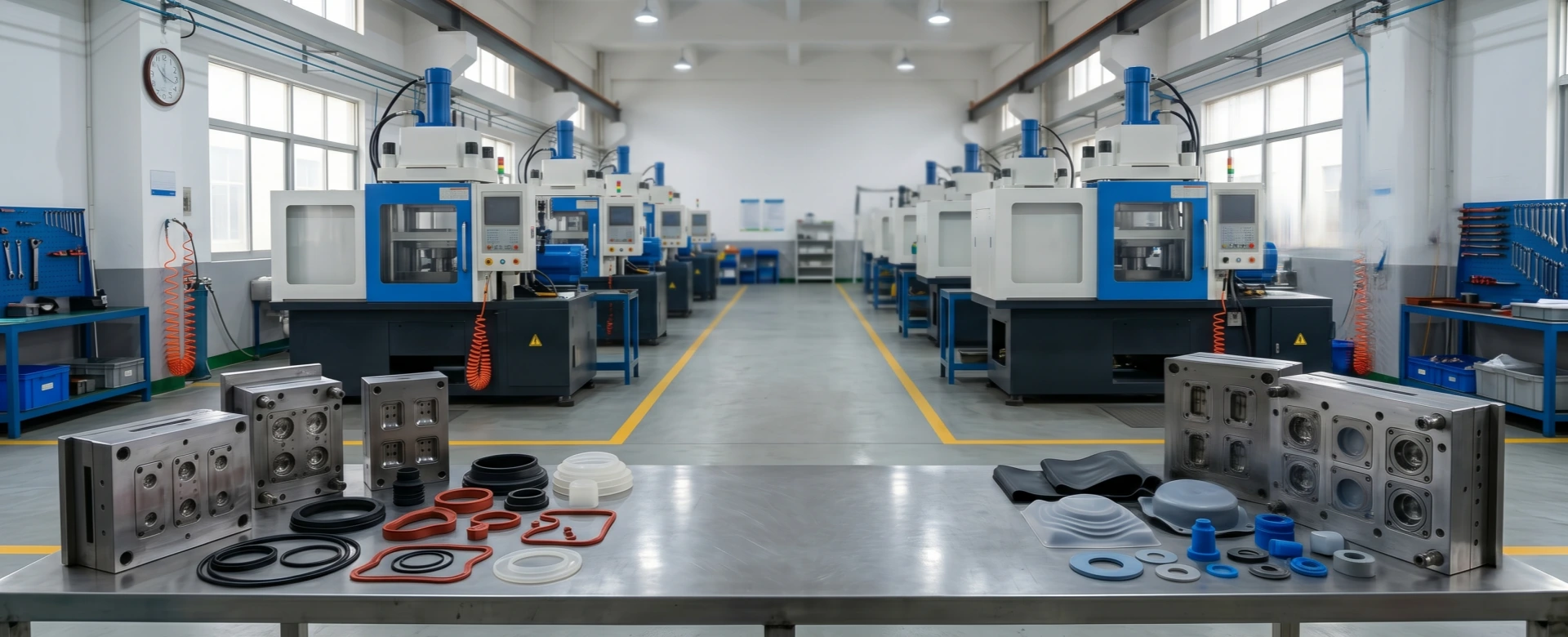
The low viscosity of raw Liquid Silicone Rubber (LSR) at high mold temperatures requires exceptional precision in tool mold design to prevent component defects. When the two halves of a multi-cavity tool interface, any parting line mismatch or clearance gap exceeding 5 microns (0.005 mm) will allow the liquid silicone to escape, creating an ultra-thin defect known as molding flash. Vestigial flash along the critical internal sealing lips or within the outer sheet-metal retention groove creates microscopic capillary pathways. When the vehicle is exposed to high-velocity water spray, capillary action draws moisture past the flash defect and into the sensitive cabin electronics area. To eliminate this risk, Reemane employs advanced CNC micro-machined tool steel molds with cold-runner valve gates and automated flashless demolding blocks. This specialized tooling holds component parting lines to sub-micron tolerances, ensuring clean sealing boundaries and a consistent manufacturing process capability index ($C_{pk} \ge 1.67$).
6. Laboratory Environmental Qualification: Verifying USCAR-2 and IPX9K Limits
To satisfy the strict validation audits of global automotive OEMs, production batches undergo rigorous environmental testing inside fully certified laboratory facilities. The testing sequences isolate specific environmental failure modes:
- ISO 20653 IPX9K High-Pressure Jet Spray Subjection: Assembled sheet-metal bulkhead fixtures containing the wire harness and compressed silicone grommets are placed inside an automated spray chamber. The interface is blasted with a high-pressure water stream (100 bar / 1450 PSI) at an elevated temperature of 80°C across multiple angles (0°, 30°, 60°, 90°). Post-test analysis requires zero moisture trace migration past the internal or external sealing boundaries.
- USCAR-2 Class 4 Accelerated Thermal Aging: Components are placed inside environmental ovens at 150°C for continuous periods up to 1000 hours. Post-aging verification requires the silicone to maintain its sealing compliance, showing an increase in Shore A hardness of ≤ 5 points and a compression set value of ≤ 15% under ASTM D395 Method B. This ensures the grommet retains its elastic memory and seal integrity over decades of field service.
- ISO 16750-3 Random Mechanical Vibration Testing: Grommet fixtures are subjected to high-frequency triaxial shakers across extreme thermal sweeps (-40°C to +150°C) to simulate continuous engine firewall stress loops. Components must reveal zero physical chafing damage, cracking, or loss of interface contact pressure.
Secure Automotive EDS Longevity with Reemane High-Precision Isolation Assets
Eliminate localized thermal breakdown pathways, eradicate wire harness chafing failures, and maintain flawless batch quality tracking across extreme high-temperature vehicle compartments. Reemane provides full hyperelastic radial sealing DFM geometry profile mapping, automated flashless injection tool setups, and certified USCAR-2 Class 4 validation reporting.